Kit or Standalone? There Is No Universal Winner
A compressor kit can offer convenience and good value when the included compressor, hose, fittings and tools match the work you actually need to do.
A kit can represent good value when it contains the compressor, hose, fittings and tools you genuinely need. Buying individually can be better when you already own part of the system, need a specialist tool, want a particular coupling standard or need substantially more airflow than a starter package provides.
Best buying rule: size the compressor around the highest realistic simultaneous air demand, then decide whether a ready-made package or individually selected accessories best meets that requirement.
What Is an Air Compressor Kit?
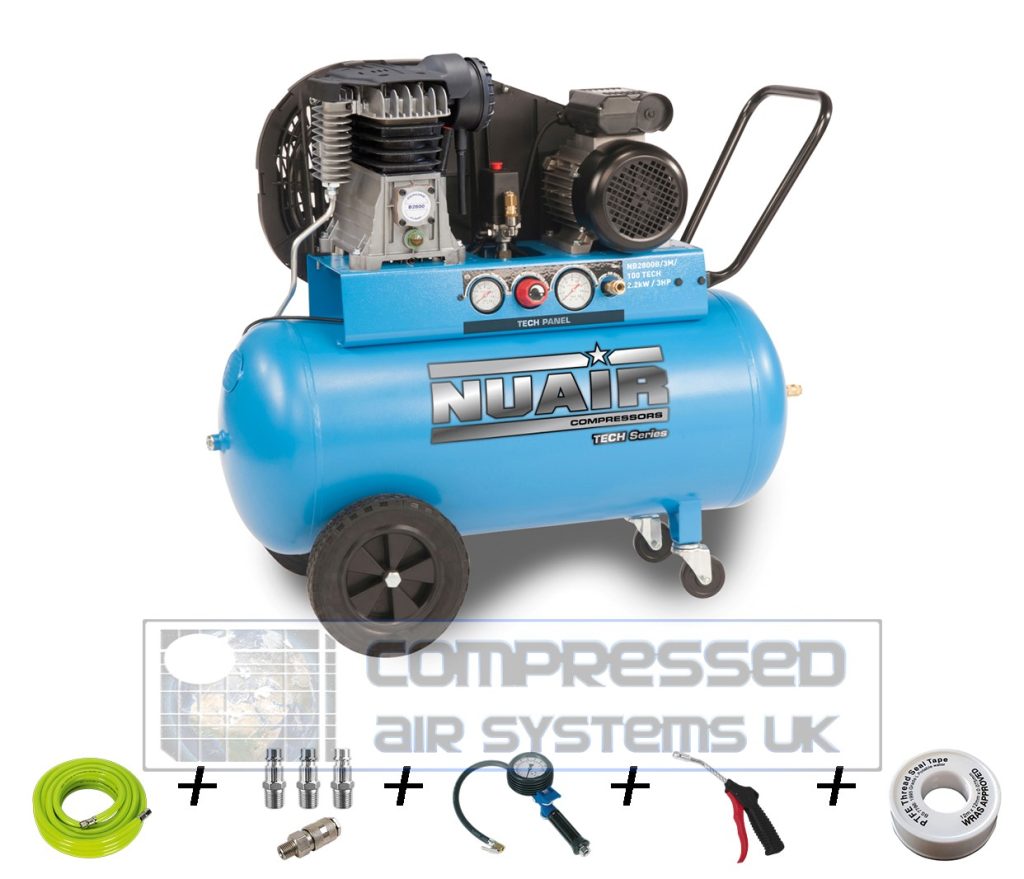
There is no fixed list of items that every kit contains. A compressor package can combine some or all of the following:
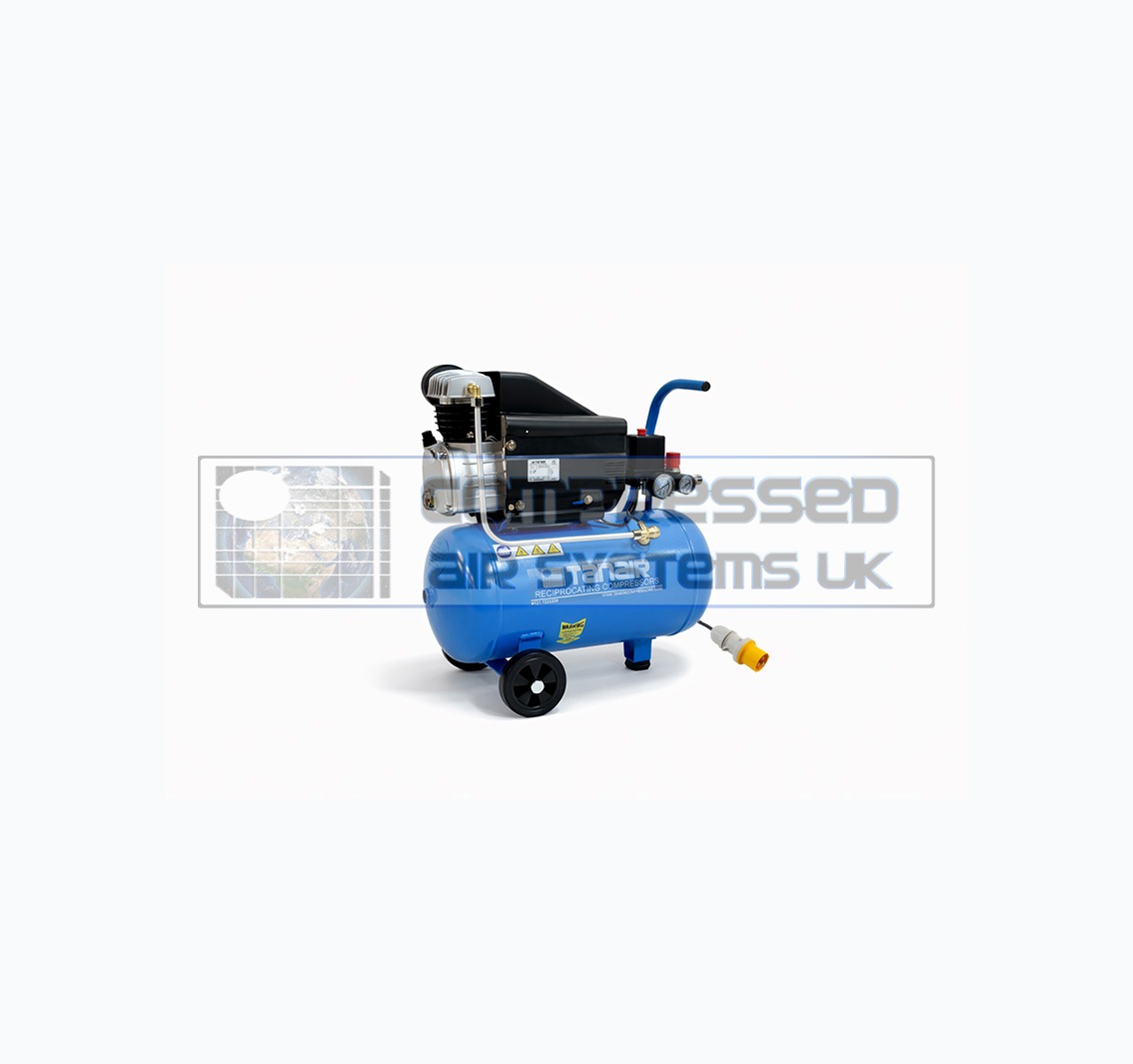
Air CompressorThe core machine, which must provide adequate usable airflow and pressure.
Air HoseMust have sufficient internal diameter, suitable pressure rating and the correct end connections.
Quick CouplingsProfiles must match the plugs used on the tools and hose.
Blow GunUseful for controlled cleaning and blow-down duties where appropriate.
Tyre InflatorCommon in garage and vehicle-maintenance packages.
Air ToolsMay include impact tools, spray equipment or other accessories depending on the exact package.
Current Tanair Compressor Kits
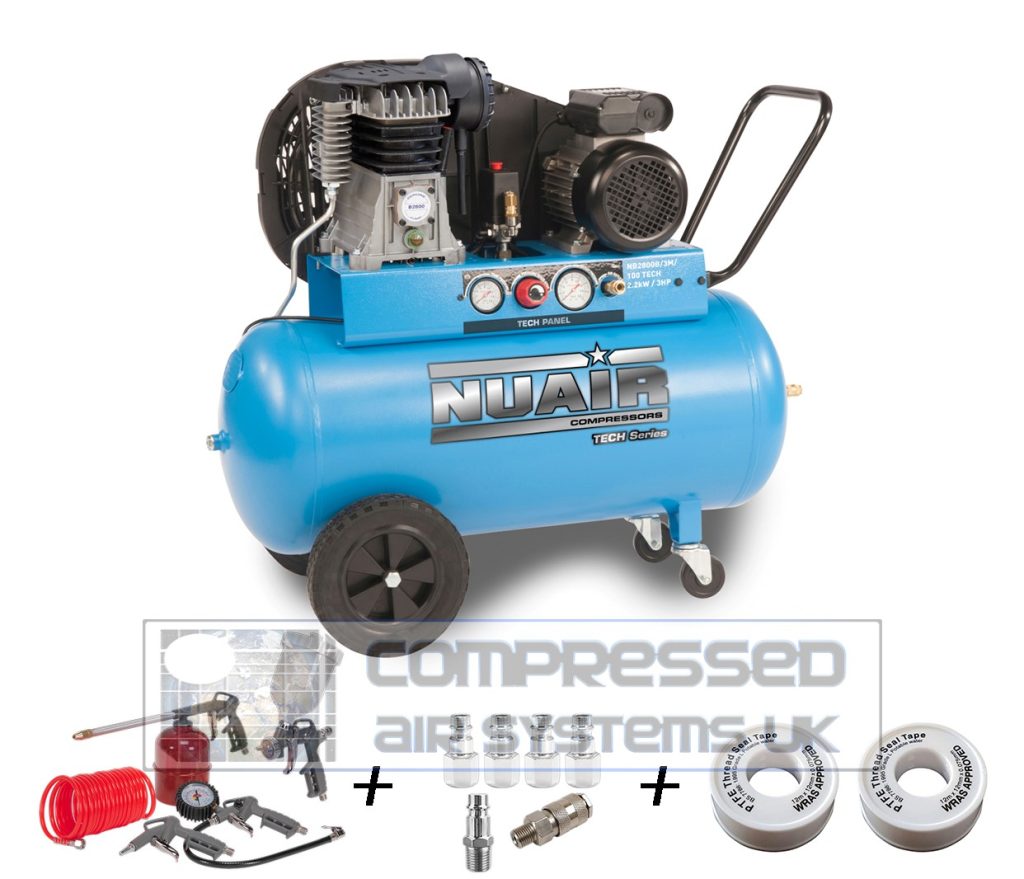
The three packages below are useful current examples built around the Nuair TECH PRO 100-litre 230V compressor. Each card uses the verified product image from the live Tanair site.
The Compressor Behind the Current Kits
The current Kit 2 and Kit 3 pages identify the Nuair NB2800B/100/3M TECH PRO as a lubricated, belt-driven piston compressor with a 100-litre receiver, 2.2 kW / 3 HP motor, 230V single-phase supply, 12.5 CFM air displacement and maximum pressure of 10 bar.
Important: 12.5 CFM is the published air displacement. Tool selection should ideally be checked against the compressor's usable/free-air delivery at the required pressure, not receiver volume or displacement alone.
Why Receiver Size Does Not Tell You Which Tools It Can Run
A larger receiver stores more compressed air, but it does not increase the pump's continuous airflow. Tool compatibility should be judged from airflow, pressure and duty cycle rather than receiver size alone.
Receiver Capacity Helps With
- Short intermittent demand peaks
- Reducing very rapid pressure changes
- Giving the compressor some stored-air buffer
Receiver Capacity Does Not
- Increase compressor CFM
- Make an undersized pump suitable for continuous tools
- Guarantee that an impact wrench, sander or spray gun will run correctly
CFM and Duty Cycle Matter More Than “Professional Tool” Labels
Impact wrenches, sanders and spray guns can have very different air requirements, so the compressor should always be checked against the exact tool specification.
| Tool Type | What to Check | Why |
|---|
| Impact wrench | Average consumption, peak demand and use pattern | Short bursts may suit a smaller compressor better than continuous operation. |
| Sander / grinder | Continuous free-air requirement | These can be demanding because they may run for long periods. |
| Spray gun | Specified air consumption and required pressure | Stable airflow and suitable air quality are important for finish quality. |
| Nailer / stapler | Air per shot and firing frequency | Intermittent operation can suit relatively modest compressor capacity. |
| Tyre inflator | Pressure range and inflation frequency | Often intermittent, but vehicle and tyre size affect demand. |
| Blow gun | Nozzle design and usage time | Open blowing can consume substantial air if used continuously. |
Do Kits Guarantee Compatibility?
A well-designed kit can remove a lot of connection guesswork because the supplied hose, plugs, sockets and adaptors have been selected together. But “kit” does not mean every included air tool can be run continuously at full performance by the compressor in every situation.
- Check the quick-release coupling profile.
- Check BSP thread sizes.
- Check hose internal diameter and length.
- Check maximum working pressure.
- Check each tool's airflow requirement and duty cycle.
- Check whether additional filtration or drying is required.
A Regulator Is Not a Moisture Separator
A filter-regulator does not perform every air-treatment function. Pressure regulation, moisture separation, filtration and drying are separate functions and should be selected to suit the application.
Pressure RegulatorReduces downstream pressure to the required setting. It does not dry the air.
Water Separator / FilterCan remove bulk liquid water or particulate contamination depending on its design.
Refrigeration DryerReduces moisture by lowering the pressure dew point for suitable workshop applications.
Coalescing FilterRemoves fine liquid aerosols and particles according to its rated performance.
Activated CarbonMay be required where oil vapour limits are particularly demanding.
Application RequirementPainting and other sensitive processes should be matched to the required air quality rather than assumed from the kit contents.
Oil-Free Is Not Automatically Better for Painting
An oil-free compressor removes the compressor lubricant source from the compression chamber, but it does not automatically provide dry, particle-free or process-grade air.
Paint quality can still be affected by atmospheric moisture, particles, dirty hoses and inadequate filtration. Select air treatment around the finish requirement.
Are Kits Always Cheaper?
No. Sometimes a package price is better than buying every component individually; sometimes it is not. Prices, promotions and the accessories actually required can all change the comparison.
A Kit Often Makes Sense When
- You are starting from scratch.
- You need most of the included accessories.
- You want the principal fittings selected together.
- The compressor capacity suits your tools.
Standalone Purchases Often Make Sense When
- You already own a suitable compressor.
- You need one specialist tool only.
- You want a different hose or coupling standard.
- Your application needs more airflow than the available kit compressor provides.
Warranty: Check Each Product, Not a Blanket “Two Years”
Warranty length and scope vary by product, brand and manufacturer, so the exact package documentation should always be checked before purchase.
Where a package contains components from different manufacturers, the applicable warranty terms can differ between the compressor and accessories. Check the product page or ask before ordering if warranty length is important to the buying decision.
Matched Accessories Do Not Automatically Reduce Electricity Use
Buying a matched kit does not automatically reduce electricity use. Compressor energy consumption depends mainly on airflow demand, operating pressure, run time, control method, leakage and compressor efficiency.
Compressor electricity use is driven primarily by airflow demand, operating pressure, run time, control method, leakage and compressor efficiency. Correctly sized hoses and couplings can avoid unnecessary pressure drop, but the saving should be measured rather than assumed.
How to Choose Between Kit 1, Kit 2 and Kit 3
| Package | Best Starting Point For | Check Before Buying |
|---|
| Kit 1 | Users wanting an impact wrench, hose and blow gun in one package. | Confirm the impact wrench's required airflow and your expected duty cycle. |
| Kit 2 | General workshop users wanting a broader five-piece accessory set. | Check the exact air demand of the spray gun and how frequently it will be used. |
| Kit 3 | Tyre, blow-down and general garage or fleet-maintenance work. | Confirm hose, coupling and tyre-inflation requirements for your application. |
Before You Buy Any Compressor-and-Tool Combination
- List every air tool you intend to use.
- Record required CFM or l/min and operating pressure.
- Decide which tools could run at the same time.
- Check compressor usable/free-air delivery, not receiver volume alone.
- Check electrical supply — current Nuair TECH PRO kit compressor is 230V single phase.
- Confirm quick-release profile and BSP connection sizes.
- Check air-quality requirements for spraying or sensitive work.
- Confirm current stock, delivery and warranty on the live product page.
Air Compressor Kit FAQs
Are compressor kits cheaper than buying everything separately?
Sometimes, but not automatically. Compare the current package price with the individual items you actually need rather than relying on a generic saving percentage.
Does a 100-litre compressor run any workshop air tool?
No. Receiver capacity stores air but does not determine continuous airflow. Check the tool's free-air demand and duty cycle against the compressor's usable output.
Is 12.5 CFM enough for an impact wrench?
It depends on the exact wrench and how it is used. Compare its specified airflow and duty cycle with the compressor's free-air delivery at the required pressure.
Can a kit run a spray gun?
Only where the compressor can sustain the spray gun's airflow and the air treatment is suitable for the required finish quality.
Is oil-free better for painting?
Oil-free removes one potential lubricant source, but painting can still require drying and filtration to control atmospheric moisture and particles.
Does a regulator remove water?
No. A pressure regulator controls pressure. Moisture removal requires suitable separation, filtration or drying equipment.
Do compressor kits have one shared warranty?
Not necessarily. Warranty terms vary by the compressor, accessory, brand and manufacturer. Check the exact package documentation.
Should I buy a kit if I already own air tools?
Only if the package still represents value and its compressor matches your existing tools. Otherwise, a standalone compressor or selected accessories may be the better choice.
Not Sure Which Compressor Kit Matches Your Tools?
Send us the air tools you want to run, their CFM and pressure requirements, how often you use them and your available electrical supply. We can help check whether a current kit is suitable or whether a different compressor would be a better choice.
Compressed Air Systems UK · Unit 15, Fortnum Close, Birmingham, B33 0LG