Air Compressor Buying Guide
How to Choose the Right Air Compressor for Your Business
The right compressor is the one that can deliver the airflow and pressure your process actually needs, at the correct duty, with suitable power, air treatment, installation space and room for sensible future demand.
Start With CFM
Check Working Pressure
Match the Duty
Plan Air Treatment
Allow for Installation
Start With the Application, Not the Motor Size
Choosing an air compressor by horsepower or kW alone is one of the easiest ways to end up with the wrong machine. Two compressors with similar motor sizes can have different delivered airflow, pressure capability, control methods and intended duty.
Before comparing models, establish what the compressed air is actually doing: which tools and machines it supplies, how many can operate together, the required working pressure, how many hours the system runs and whether the air needs to be dried or filtered.
Best starting point: identify the required airflow in CFM or m³/min at the actual working pressure. Then check duty, electrical supply, receiver size, air treatment, noise, installation space and future demand.
1. Calculate the Airflow You Really Need
Every pneumatic tool or process has an air-consumption requirement. Add together the demand of equipment that can genuinely operate at the same time rather than simply adding every item connected to the ring main.
CFM
Cubic feet per minute is commonly used to describe compressor airflow. When comparing machines, make sure you understand whether the quoted figure is displacement or delivered/free-air performance.
Simultaneous Demand
Consider which tools or machines run together, their duty pattern and whether short peaks in demand are supported by the receiver or require additional compressor capacity.
Avoid chronic undersizing: a compressor that spends too much time trying to satisfy demand can run hotter, cycle poorly or fail to maintain pressure. Oversizing can also be inefficient, particularly where demand is low or highly variable.
2. Confirm the Required Working Pressure
The compressor must provide enough pressure at the point of use after allowing for losses through dryers, filters, pipework, valves, hoses and fittings. Do not automatically select a higher-pressure compressor “just in case”.
- Check the manufacturer's pressure requirement for the tools or machinery.
- Identify the highest genuine pressure requirement on the system.
- Allow for reasonable distribution and treatment pressure losses.
- Investigate excessive pressure drop rather than permanently increasing compressor pressure to mask it.
3. Choose the Right Compressor Type
Piston Compressor
Often well suited to workshops and intermittent-demand applications. Available in direct-drive, belt-drive, silenced, portable and stationary formats.
Rotary Screw Compressor
Common in industrial applications with higher or more sustained demand, where continuous compressed-air availability and lower operating noise may be important.
Variable Speed Screw
Useful where demand varies significantly and the compressor can adjust motor speed to follow the required airflow within its operating range.
Fixed Speed Screw
Can be a practical choice where compressed-air demand is comparatively stable and the compressor is correctly matched to the load profile.
Silenced Compressor
Consider an enclosed or low-noise design where the compressor is installed near occupied workshop or production areas.
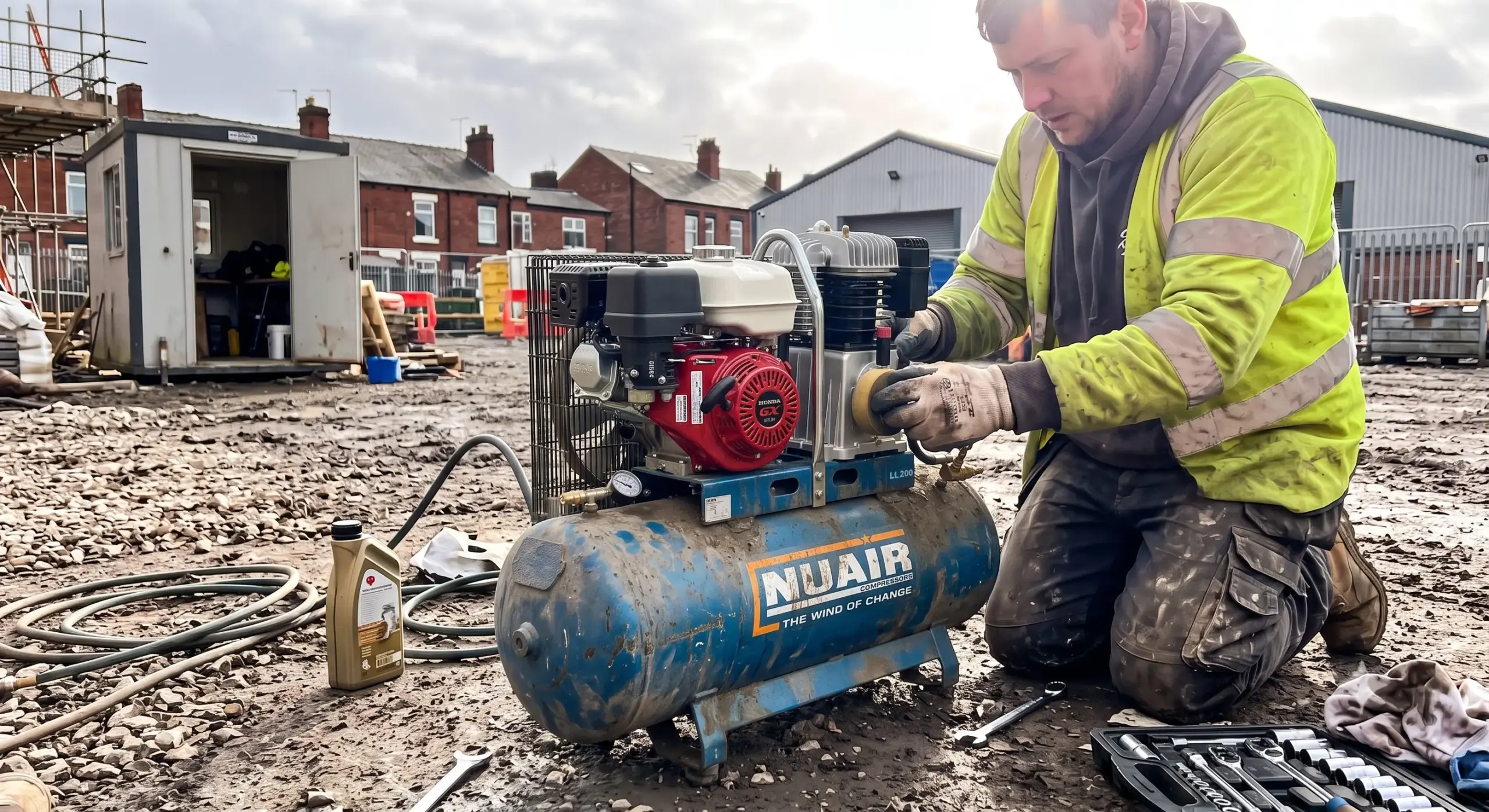
Petrol / Engine Driven
Useful where a suitable mains electrical supply is unavailable. Ventilation, exhaust-gas safety and the intended operating environment must be considered.
4. Match the Compressor to the Duty
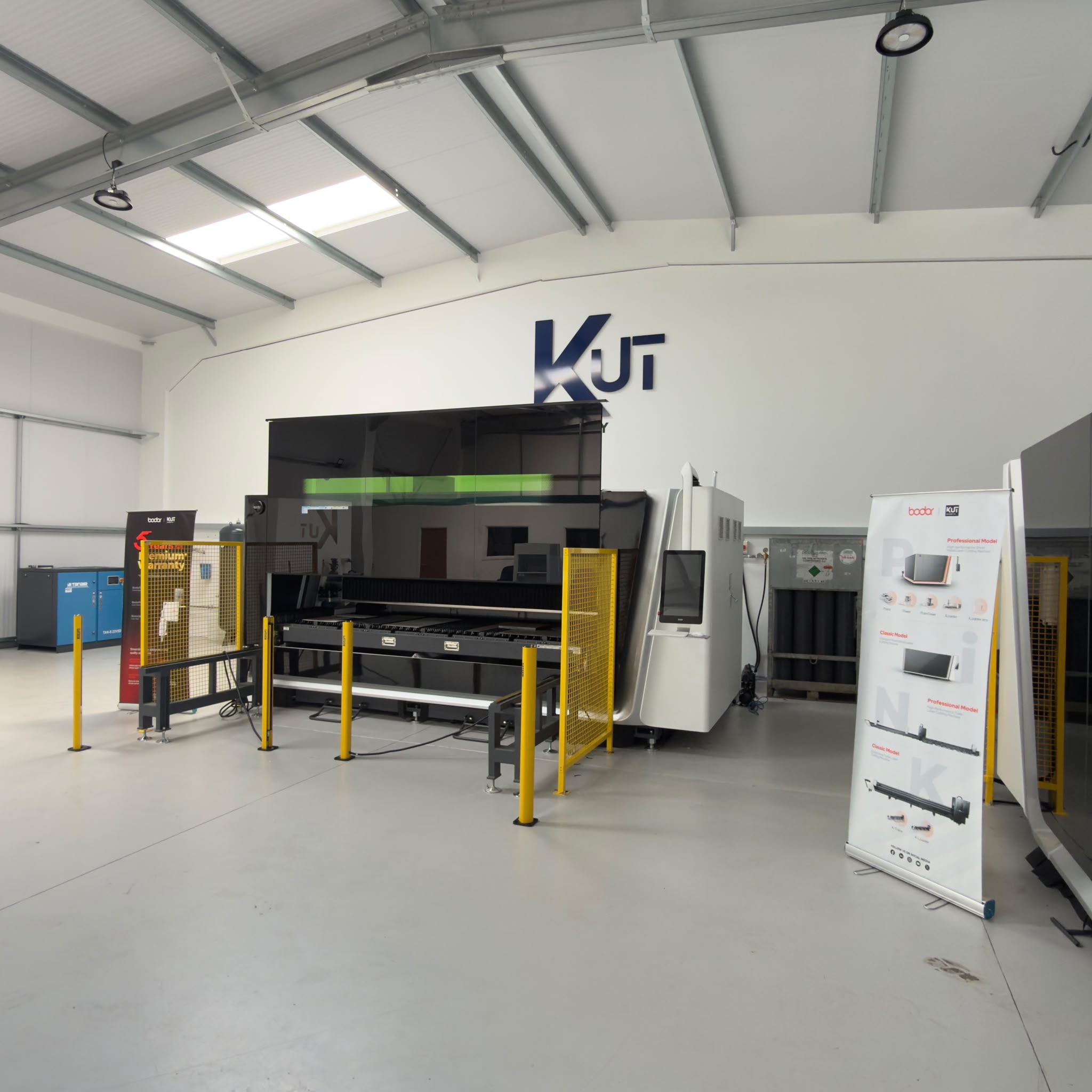
Duty matters as much as peak airflow. A compressor supplying intermittent workshop tools may have a very different operating pattern from one feeding CNC machinery or a production line throughout a shift.
Intermittent Demand
A correctly sized piston compressor and receiver may be appropriate where demand comes in shorter bursts and the compressor has adequate recovery time.
Sustained Industrial Demand
Rotary screw compressors are commonly considered where demand is sustained for long periods. The final selection should reflect the manufacturer's intended duty and the site's load profile.
5. Check Your Electrical Supply
Before ordering an electric compressor, confirm the voltage, phase and available electrical capacity at the proposed installation point. A machine being described as “230V” does not automatically mean it is suitable for a standard domestic-style 13A socket.
- 230V or 400/415V supply
- Single-phase or three-phase requirement
- Required protective device and starting characteristics
- Local isolator and cable sizing
- Any separate supply required by an integrated or standalone dryer
Electrical work: installation requirements should be checked against the compressor manufacturer's instructions and completed by a suitably competent electrical contractor where necessary.
6. Think About Receiver Size
An air receiver stores compressed air, helps buffer short peaks in demand and can reduce rapid compressor cycling when correctly incorporated into the system. A larger receiver does not compensate for a compressor that is fundamentally too small for sustained demand.
The appropriate receiver arrangement depends on compressor control, airflow demand, allowable pressure variation and the characteristics of the process.
7. Decide What Air Quality the Process Needs
Atmospheric air contains water vapour and particles before it reaches the compressor. Depending on the compressor and process, the downstream system may also need to control oil aerosols, condensate and pipework contamination.
Refrigeration Dryer
Commonly used where reducing moisture and controlling condensation is important for general industrial compressed air.
Filtration
Different filter grades reduce different types and sizes of contamination. Select filtration around the required delivered air quality.
Application Requirement
Where air quality is process-critical, use the machinery specification or relevant purity requirement rather than assuming a generic treatment package.
See our compressed air quality guide and air quality testing service for more detailed guidance.
8. Allow Enough Space, Ventilation and Service Access
Even the correct compressor can become troublesome if it is installed in the wrong environment. Check the manufacturer's clearance and ventilation requirements before deciding where the machine will go.
- Enough space to remove service panels and carry out maintenance
- Suitable ventilation and heat rejection
- A clean intake environment where practical
- Safe access for engineers and component replacement
- Suitable pipework connections and drainage arrangements
- Plant-room temperature within the manufacturer's permitted range
9. Consider Noise Before the Compressor Arrives
Noise can influence both machine selection and installation location. Where compressors operate close to people, compare manufacturer-stated sound data and consider whether a silenced cabinet, separate plant room or different compressor technology is more suitable.
Noise exposure in the workplace is a wider health-and-safety issue, so compressor sound should be considered alongside the rest of the equipment in the working environment rather than in isolation.
10. Fixed Speed or Variable Speed?
Fixed Speed
A fixed-speed screw compressor can be a sensible choice where demand is steady and the machine is correctly sized. Simpler operation does not automatically mean higher energy use in every application.
Variable Speed
A variable-speed compressor can reduce unloaded running and better match changing airflow demand. The potential benefit depends on the site's load profile, operating hours, pressure requirement and how well the compressor is sized.
Do not invent a savings percentage: the realistic way to assess a VSD opportunity is to understand actual demand and operating hours, ideally using measured system data where the investment is significant.
Current Compressor Examples From the Original Guide
The original article included the following live product links. They are retained here as useful examples of different compressor formats, voltages, receiver sizes and output levels. Check each product page for the latest specification, price and availability.
Nuair AIRSIL1 B2800B/3CT-10011.6 CFM low-noise piston compressor.View product →
Nuair Roll Cage OM 195/67.1 CFM compact 230V roll-cage compressor.View product →
Nuair NB3800B/150V FM3 PRO13.95 CFM vertical 230V piston compressor.View product →
Nuair B3800/5.5S/10+10 Honda13.8 CFM petrol-driven piston compressor.View product →
Nuair ND2/24 CM27.4 CFM compact piston compressor.View product →
Nuair Vento OM200/6 SILENT4.1 CFM compact low-noise direct-drive compressor.View product →
Nuair NB2800B/50/2M TECH PRO9 CFM 230V piston compressor.View product →
Nuair NB3800B/150V FT313.95 CFM 400V vertical piston compressor.View product →
Fini Pulsar Ultimate K30-270-5.5 TA25.6 CFM silenced piston compressor.View product →
Fini Pulsar Ultimate K30-270-7.5 TA31 CFM silenced piston compressor.View product →
Fini Pulsar Ultimate K50-270-10 SD38 CFM silenced piston compressor.View product →
TAN10-VSD/10 Floorpack415V floor-mounted variable-speed screw compressor.View product →
TAN15-VSD-RD415V receiver-mounted variable-speed screw compressor with dryer and filtration.View product →
Fini PLUS 808-270 ES44.1 CFM receiver-mounted screw compressor with dryer.View product →
Which Brand Should You Choose?
Brand matters, but it should come after the application. A well-supported compressor that is correctly sized for the job is usually a better purchase than choosing a brand first and forcing the application around whatever model happens to be available.
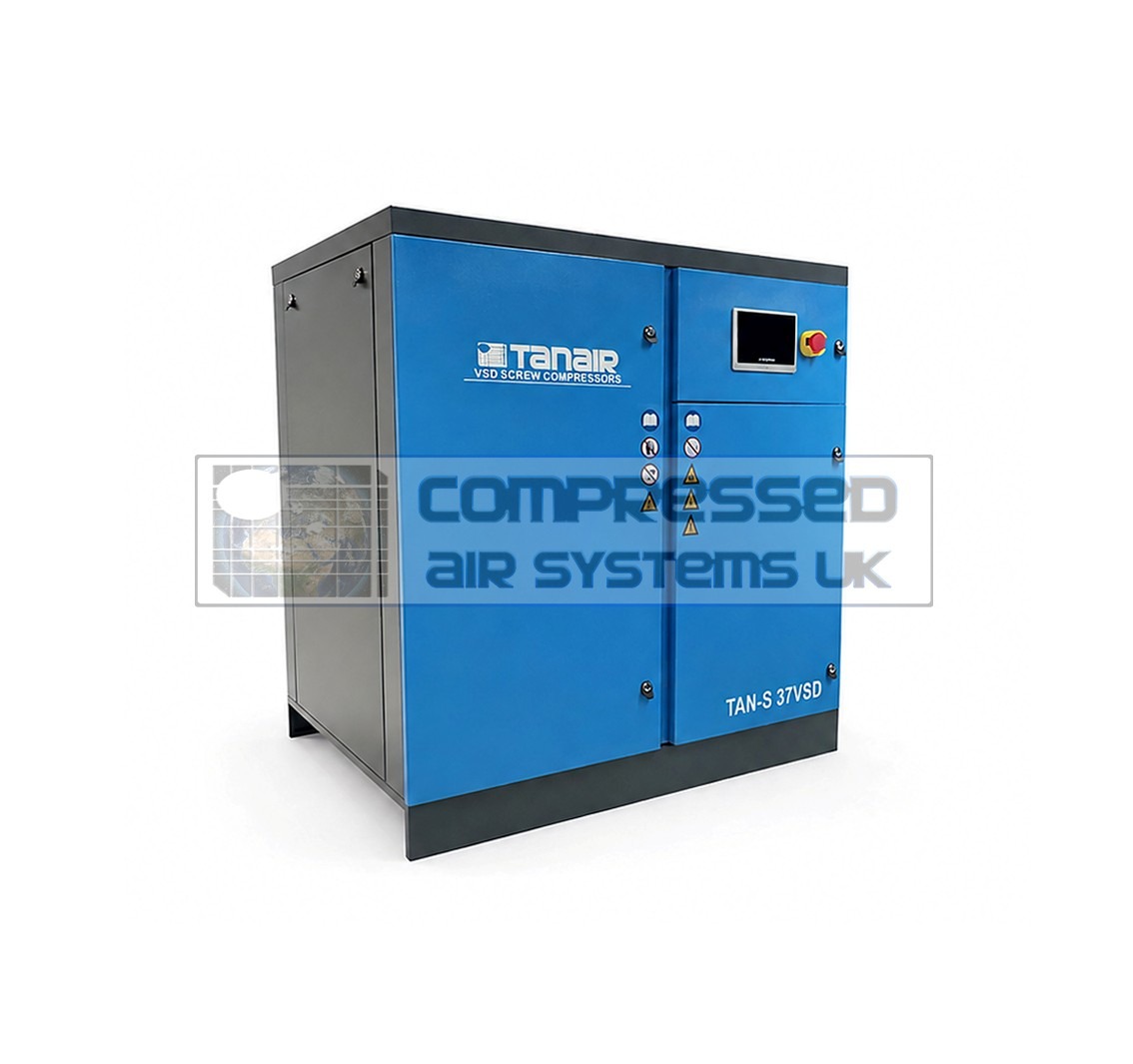
Tanair
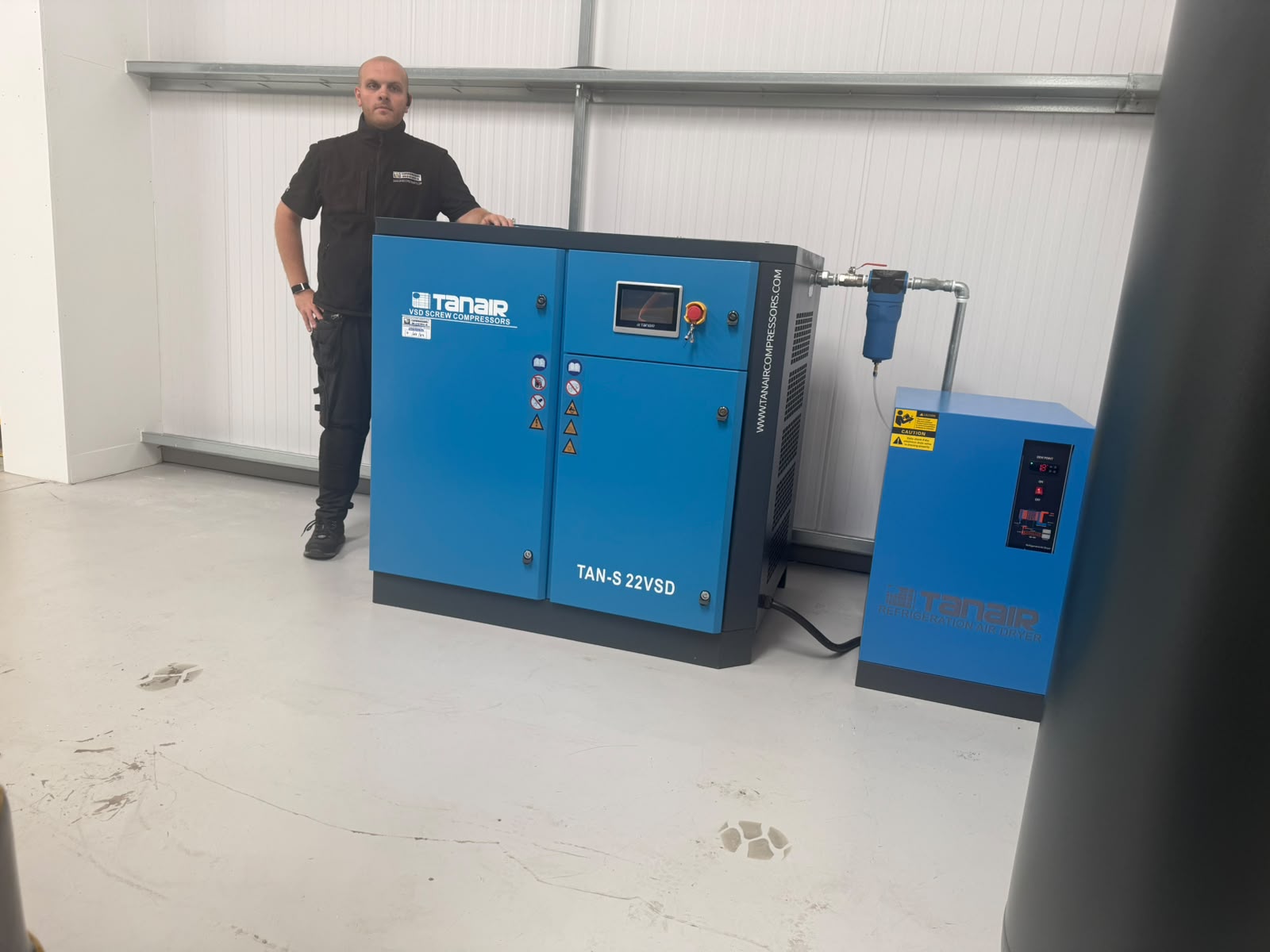
Our own range includes industrial piston and variable-speed screw options for businesses that want support directly from Compressed Air Systems UK.
Nuair
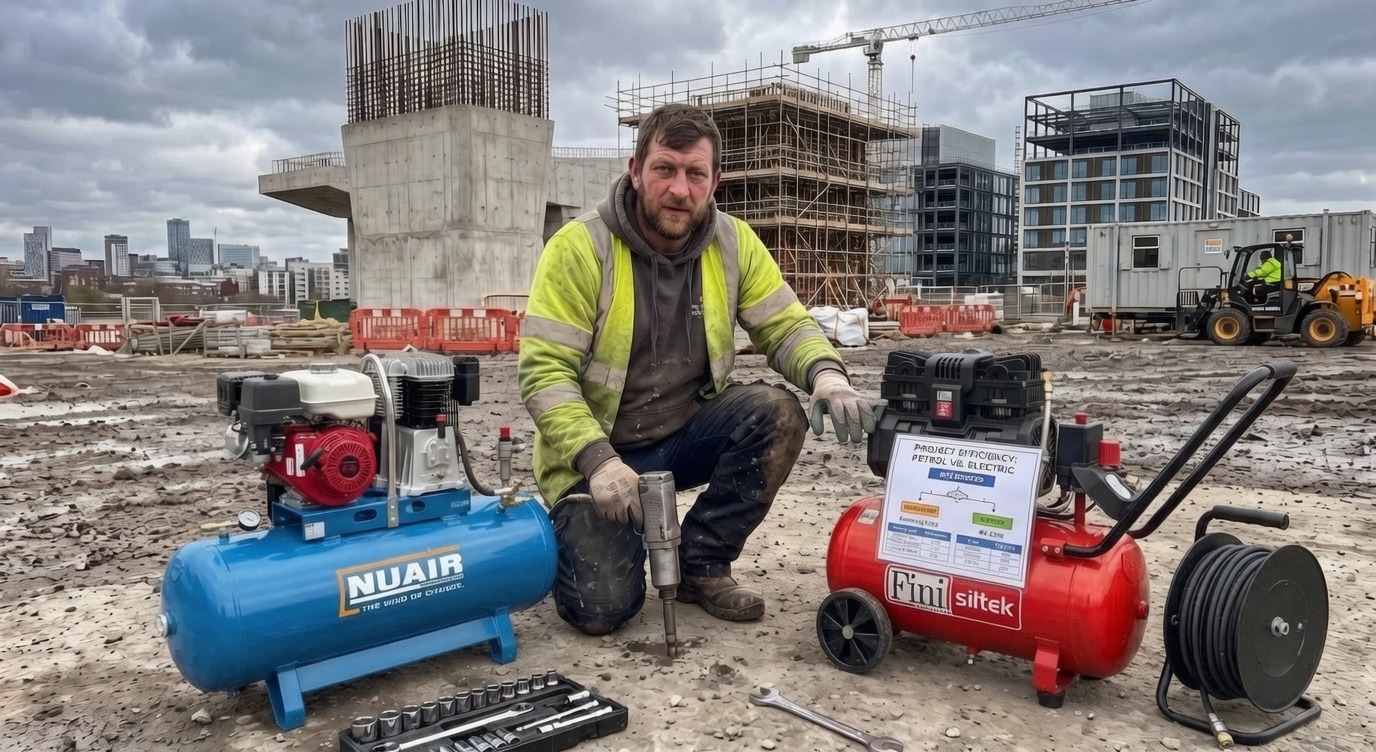
A broad selection of piston, portable, stationary and silenced compressors suited to many workshop and light-industrial applications.
Fini
Includes piston and rotary-screw ranges, with compact, silenced and integrated-dryer options for different applications.
Power System
Industrial compressor options for businesses requiring rotary-screw equipment and engineered compressed-air solutions.
Hydrovane
Rotary-vane compressor technology suited to applications where its operating characteristics match the site's requirement.
Support Matters Too
Consider parts availability, servicing, technical support and the ability to maintain the compressor throughout its working life.
What If You Are Still Not Sure?
If the compressor is replacing an existing machine, start with the make, model, pressure and airflow of the current unit, then explain what has changed. If it is a new application, provide the air consumption of the connected equipment, intended operating hours and electrical supply.
For larger or more complex systems, a site assessment can help identify actual demand, pressure issues, air-treatment requirements, pipework limitations and opportunities to improve the overall compressed-air system rather than simply replacing one machine like-for-like.
Hire Can Be Useful While You Decide
Where a compressor has failed or the future requirement is still changing, temporary or contract hire can provide another route instead of making a rushed purchase.
Availability and suitability depend on the required airflow, pressure, electrical supply, connections and duration. See our air compressor hire options for more information.
24/7 emergency breakdown contact: call 0121 753 3330 for urgent compressor breakdown assistance. Normal sales, ordering and trade-counter services are subject to normal opening arrangements.
Choosing an Air Compressor: FAQs
How do I know what size air compressor I need?
Start with the airflow required by the tools or machinery that may operate at the same time, then confirm the working pressure and duty. The compressor should provide enough delivered air at that pressure without being unnecessarily oversized.
Should I choose an air compressor by horsepower or kW?
No. Motor power is useful specification information, but it does not tell you the complete airflow, pressure or duty capability of the compressor. Compare delivered performance at the pressure your application needs.
Is a bigger air receiver always better?
No. A receiver can buffer short-term demand and reduce rapid cycling, but it does not create additional compressor airflow. Receiver sizing should suit the system and compressor control arrangement.
Do I need a piston or screw compressor?
Piston compressors are often suitable for intermittent workshop demand, while rotary screw compressors are commonly used for more sustained industrial requirements. The correct choice depends on airflow, duty, operating hours, environment and budget.
Is variable speed always more efficient?
No. Variable speed can be particularly useful where air demand changes significantly, but actual performance depends on the load profile and correct sizing. A well-sized fixed-speed compressor may still be appropriate for stable demand.
Do I need a dryer with my compressor?
That depends on the process and acceptable moisture level. Where condensation or moisture would damage machinery or affect production, a correctly sized dryer may be required.
Can you help size a compressor from my existing machine?
Yes. Provide the existing make, model, airflow, pressure, operating pattern and details of any changes to your production demand so the replacement requirement can be assessed.
Is your support available 24/7?
Our emergency breakdown contact is available 24/7 for urgent compressor breakdown assistance. Normal customer service, sales, ordering and trade-counter services are not 24/7.
Need Help Choosing the Right Compressor?
Tell us what the compressor needs to power, the required CFM and pressure, your electrical supply and expected operating hours. We can help narrow down the most appropriate options.
Compressed Air Systems UK · Unit 15, Fortnum Close, Birmingham, B33 0LG
Explore More of Our Articles