Existing Article Product
Air line fittings connect compressors, hose, pipework, tools and pneumatic equipment. The right fitting needs to match the connection profile, BSP thread, hose or tube size, working pressure and required airflow — not simply look similar to the part being replaced.
Air line fittings are the connectors used between compressors, hoses, fixed pipework, filters, regulators, tools and pneumatic machinery. Depending on the fitting type, the connection may be threaded, quick-release, barbed, compression or push-to-connect.
The fitting should maintain a secure pressure-rated connection without introducing unnecessary restriction into the airflow path.
PCL Standard and Euro/XF are both commonly encountered in UK workshops, but they use different plug profiles and are not directly interchangeable.
A familiar profile in many established UK workshops and garages. Suitable where the existing hose and tool network already uses the matching coupling.
Often chosen where a larger internal flow path is helpful for higher-air-demand tools. Actual bore and flow capacity should be checked against the specific product.
BSP threads are widely used on compressed-air equipment in the UK. Before ordering, confirm nominal BSP size, male or female connection, and whether the fitting uses a parallel or tapered thread arrangement.
BSP and NPT should not be treated as interchangeable simply because the threads look similar.
There is no useful universal pressure rating for “quick-release”, “threaded” or “pushfit” fittings as a category. Ratings vary by design, material, size and manufacturer.
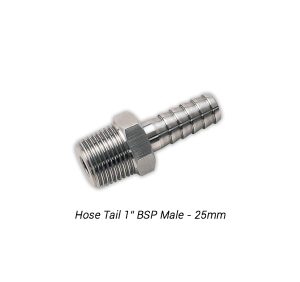
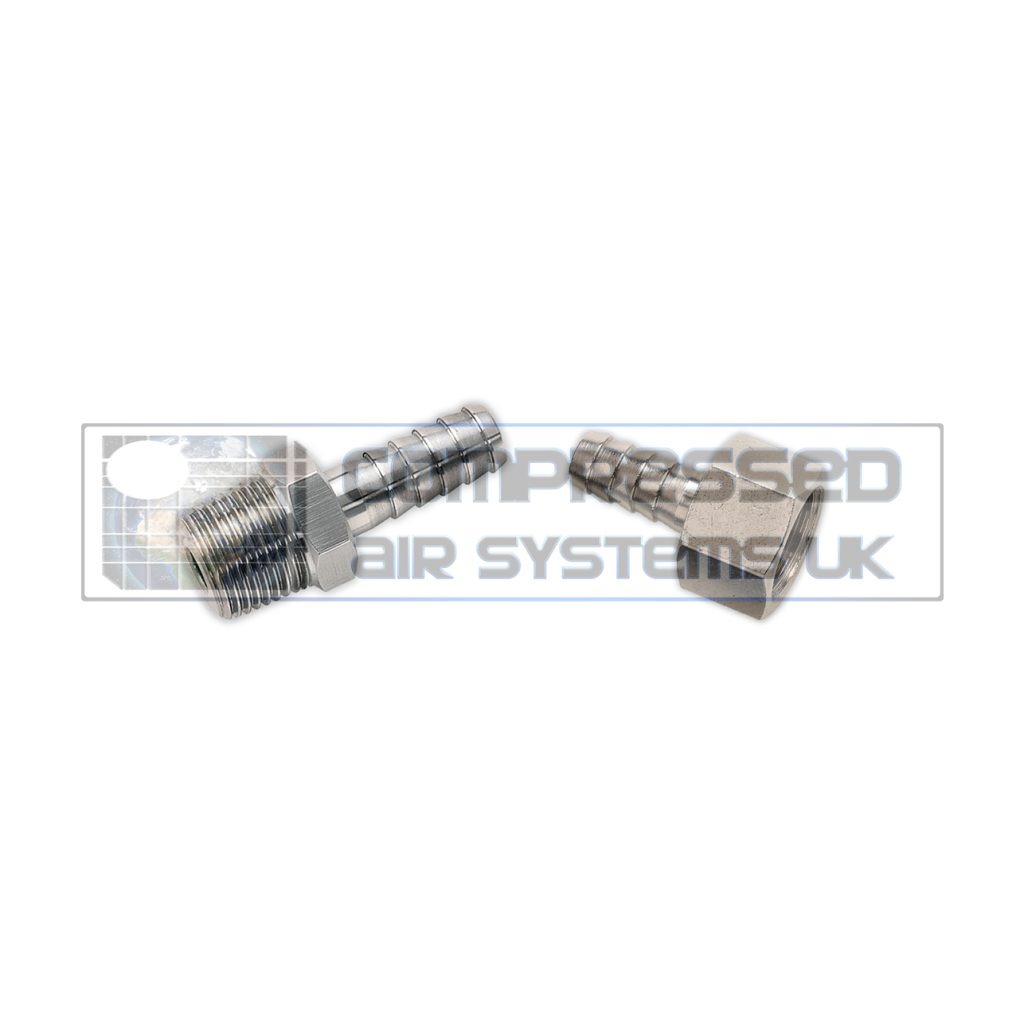
The live article contains eight hose-tail products. Their existing product routes and exact article image URLs are retained below.


A hose tail should match the hose internal diameter closely enough to provide a secure connection without unnecessarily restricting the air path or damaging the hose during assembly.
Pushfit fittings are fast and compact when they are used with compatible pneumatic tubing. Reliability depends heavily on tube preparation and correct sizing.
Fittings can become one of the most restrictive or leak-prone points in a compressed-air system. Common symptoms include a hissing coupling, pressure that falls only while the tool is running, an impact wrench losing power, or the compressor cycling more frequently than expected.
Fittings do not need arbitrary replacement at fixed annual intervals if they remain serviceable. Instead, inspect the system routinely and replace components when wear, leakage, corrosion or damage is identified.
Standard workshop fittings should not automatically be used for breathing air, medical gases, food-contact air or chemically aggressive environments. Those duties may require specific materials, cleanliness controls, approvals and validated components.
No. They use different coupling profiles. Match male plugs and female couplings to the same system or use a suitable adaptor where required.
That depends on the actual internal bore and design. Larger-bore couplings generally create less restriction, but the hose, regulator, filter and pipework must also be sized correctly.
Check the outside diameter of a male thread, the thread pitch, whether it is parallel or tapered, and compare those measurements with a BSP identification chart.
No. A matching 1/4" thread does not guarantee the same coupling profile, internal bore, pressure rating or sealing arrangement.
Replace them when damaged, worn, leaking, corroded or no longer operating correctly. A fixed replacement interval is not a substitute for inspection.
Only use a lubricant compatible with the coupling, seals and downstream process, and only where the manufacturer permits it. Contamination-sensitive systems may prohibit lubrication.
Send us a clear photograph plus the thread size, hose or tube size, coupling profile if known, and what the fitting connects to. That is much more reliable than matching by appearance alone.
Call 0121 753 3330 or use the Contact Us page.
The correct fitting should connect safely without becoming the weak point or bottleneck in the compressed-air system.
Browse Air Line Fittings