
How to Choose the Right Air Compressor for CNC Laser Cutting Machines
A practical UK guide to compressor sizing, airflow, operating pressure, air quality, refrigeration dryers, filtration, receivers and pipework for CNC and fibre laser cutting machinery.
Key areas covered in this guide
Choosing an air compressor for CNC laser cutting involves far more than comparing motor sizes. Use the links below to jump directly to the information most relevant to your project.
Compressed Air Is a Critical Part of the Laser Installation
When a business invests in a CNC laser cutting machine, attention naturally focuses on the cutting equipment itself. However, the compressed air system supporting that machinery can have a major influence on reliability, productivity, air quality and operating cost.
A compressor that cannot deliver the required airflow at the correct operating pressure may cause unstable performance, pressure-related alarms or interruptions during production. Poorly treated air can also introduce moisture, particles and oil aerosols into sensitive downstream equipment.
For this reason, an air compressor for CNC laser cutting machines should be specified as part of the overall production system rather than selected as an isolated purchase.
Important: Always confirm the airflow, pressure and air-quality requirements with the laser manufacturer or machinery supplier. Requirements vary between machine models, cutting processes and assist-gas arrangements.
Why Do CNC Laser Cutting Machines Need Compressed Air?
Compressed air can perform several functions within a modern CNC or fibre laser installation. The exact use depends on the machine specification and production process.
Whatever role compressed air performs, the supply must remain stable during production. A pressure reading taken while the laser is idle does not necessarily prove that the compressor can maintain the required performance under full demand.
Airflow, Pressure and Duty Cycle: The Three Essential Requirements
Compressor selection begins with the machinery requirement, not the compressor motor rating. Three figures are particularly important: required airflow, operating pressure and how continuously the air will be used.
Required Airflow
Airflow is commonly expressed in cubic feet per minute (CFM), litres per minute or cubic metres per hour. For compressor selection, the useful figure is normally the compressor's delivered airflow or free air delivery rather than displacement alone.
Operating Pressure
The compressor must supply the required airflow at the machinery's operating pressure after accounting for pressure losses through the dryer, filters and pipework. Selecting a compressor using airflow at the wrong pressure can lead to an undersized system.
Duty Cycle and Usage Pattern
A machine operating occasionally has a different demand profile from a production facility running multiple shifts. Shift pattern, cutting schedule, simultaneous equipment and expected future use should all be considered.
Why Compressor Selection Cannot Be Based on kW Alone
Two compressors with similar motor power may deliver different airflow depending on their design, pressure setting, control method and operating efficiency. This is why selecting a compressor by motor size alone is unreliable.
| Factor | Why It Matters | Risk if Ignored |
|---|---|---|
| Delivered airflow | The compressor must meet total demand at the required pressure. | Pressure loss and machinery interruptions. |
| Operating pressure | Higher pressure generally changes available airflow and energy use. | Incorrect sizing and excessive running cost. |
| Duty cycle | The compressor must suit the number of operating hours and load pattern. | Overheating, excessive cycling or premature wear. |
| Other equipment | Additional machines may operate from the same air system. | Insufficient capacity when demand overlaps. |
| Future expansion | Planned machinery additions may change airflow requirements. | Expensive system modifications later. |
| Pressure losses | Dryers, filters, valves and pipework introduce resistance. | Correct compressor pressure but inadequate pressure at the machine. |
Allow a sensible design margin, not uncontrolled oversizing. An undersized compressor may fail to maintain pressure, while an oversized fixed-speed compressor can spend excessive time running off-load.
Why Clean, Dry Compressed Air Matters
Atmospheric air naturally contains water vapour and airborne particles. The compressor may also introduce trace oil aerosols depending on its design. Without suitable treatment, these contaminants can enter pipework and downstream machinery.
- Moisture can collect in pipework and pneumatic equipment
- Particles can contaminate valves and sensitive components
- Oil aerosols may be unsuitable for certain applications
- Corroded pipework can introduce further contamination
- Incorrectly sized filters may create avoidable pressure loss
Refrigeration Air Dryers
A refrigeration dryer cools the compressed air so moisture can condense and be removed before the air reaches the distribution system. The dryer must be correctly sized for airflow, inlet temperature, ambient conditions and operating pressure.
Compressed Air Filtration
Filtration stages can be selected to reduce solid particles, water aerosols and oil aerosols. The required treatment level should be based on the machinery specification and the quality required at the point of use.
Why Variable Speed Compressors Suit Changing Manufacturing Demand
Manufacturing demand is rarely identical every minute of the day. Machines start and stop, production schedules change and additional pneumatic equipment may operate intermittently.
A variable speed drive compressor adjusts motor speed and air output more closely to the demand on the system. Where demand varies significantly, this can reduce unnecessary off-load running and help maintain steadier system pressure.
What Does the Air Receiver Do?
A compressed air receiver provides stored capacity within the system. It can help accommodate short peaks in demand, stabilise pressure and reduce rapid compressor cycling.
The correct receiver size depends on compressor capacity, pressure, demand pattern and the way the connected machinery uses air. A receiver should not be used to disguise a compressor that is fundamentally too small, but it remains an important part of a properly specified system.
Compressed Air Pipework for CNC Workshops
Even a correctly sized compressor can perform poorly if the distribution pipework is restrictive, leaking or badly routed. Pipe diameter, total distance, fittings, bends, isolation points and future branch connections all influence pressure at the machinery.
- Correct pipe diameter to limit pressure drop
- Efficient routing between the compressor and machinery
- Suitable isolation points for maintenance
- Drainage and condensate considerations
- Allowance for additional machinery where appropriate
- Practical access for inspection and modification
Installing the pipework at the same time as the compressor allows the full system to be assessed before production begins.
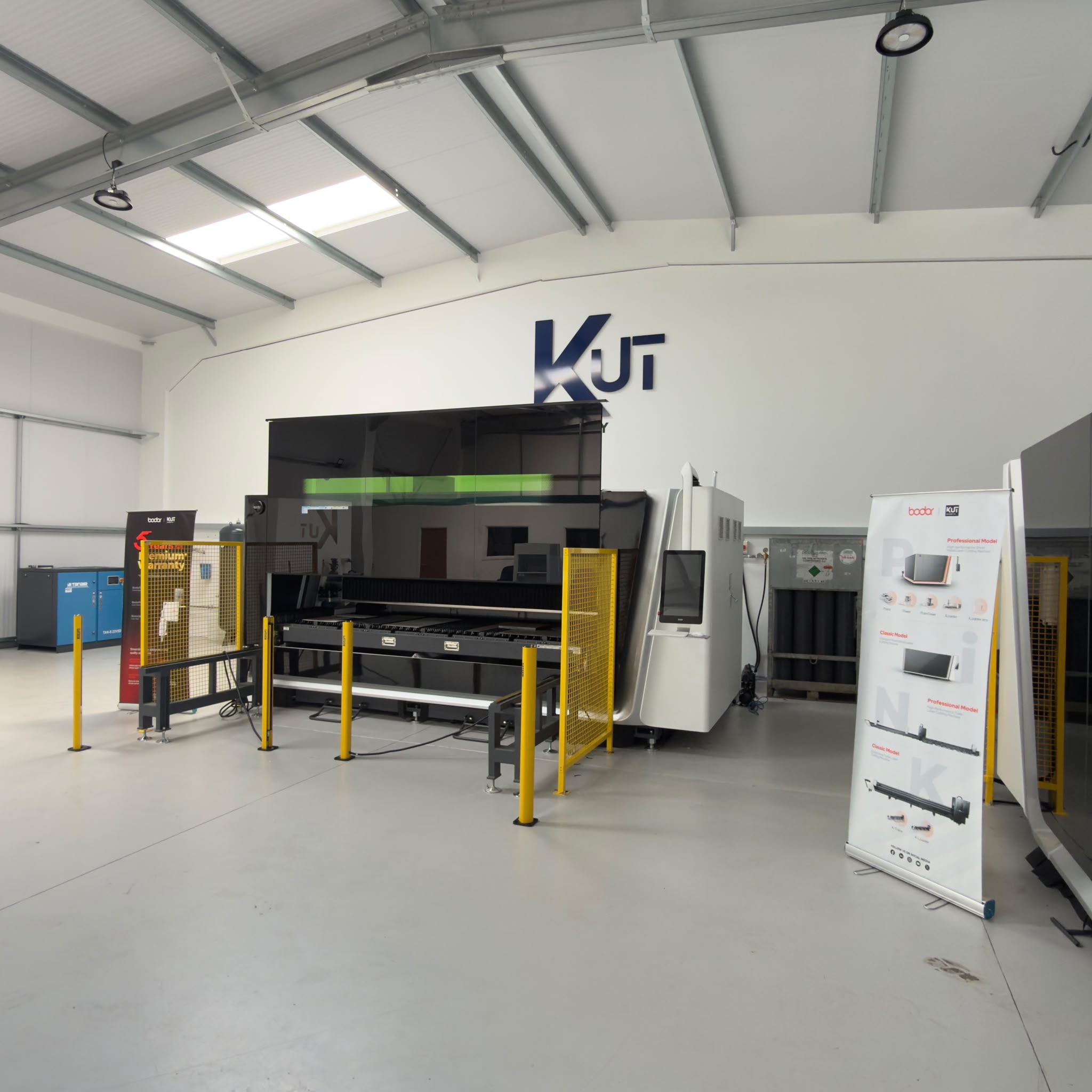
Real-World Example: KUT Machinery Ltd
Compressed Air Systems UK recently supplied, installed and commissioned a Tanair compressed air system for the KUT Machinery showroom in Kidderminster.
KUT Machinery supplies laser cutting, press brake, deburring and manufacturing equipment. The showroom installation demonstrates how compressor capacity, drying, filtration, storage and distribution pipework can be planned around modern production machinery.
- Tanair TAN-S 22VSD compressor
- Up to approximately 113 CFM
- TAN-RD-36 refrigeration dryer
- High-efficiency filtration
- 500-litre vertical receiver
- Compressed air distribution pipework
- Testing and commissioning
- Customer handover and support
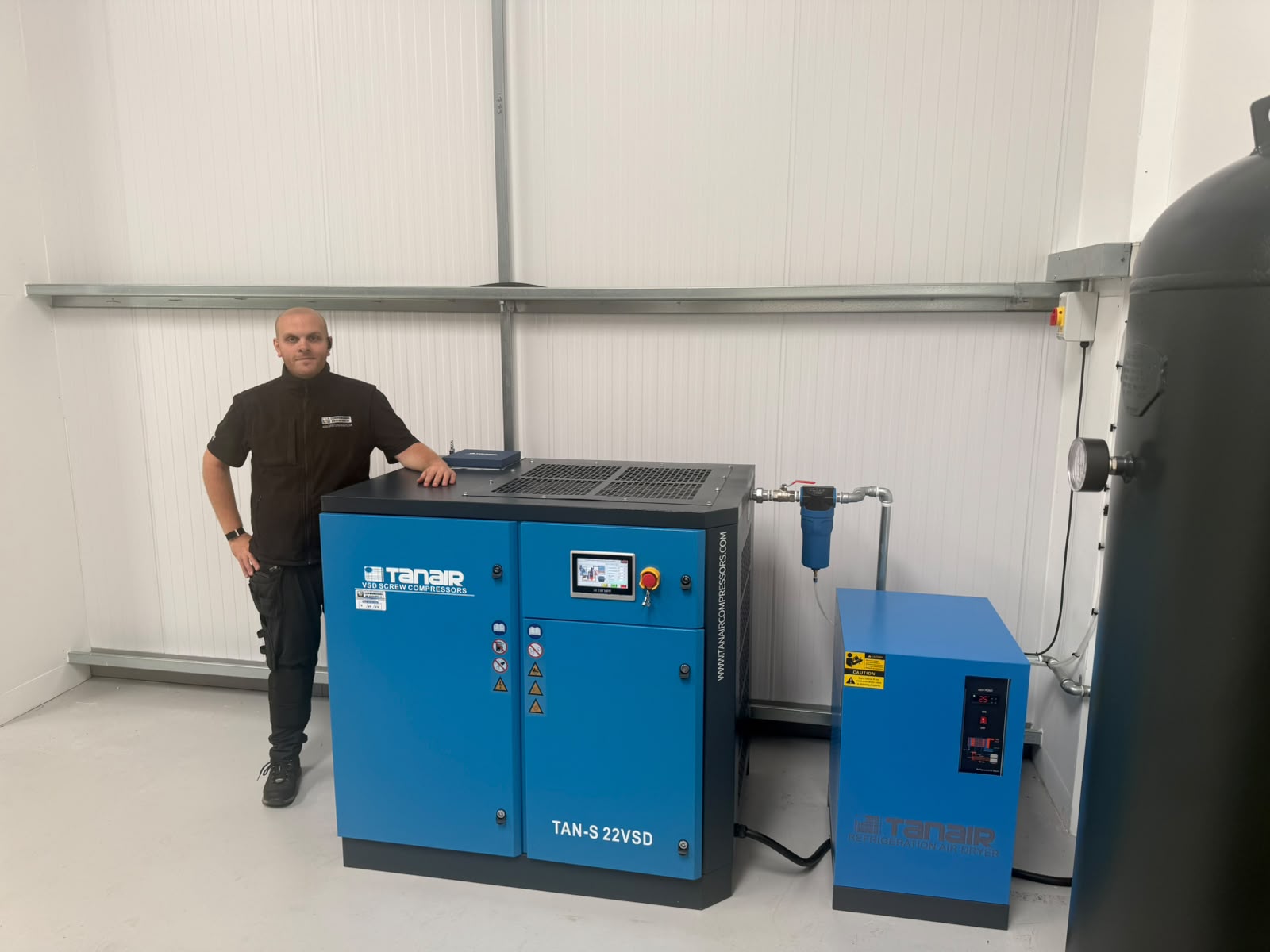
The installation was tested and commissioned before customer handover.
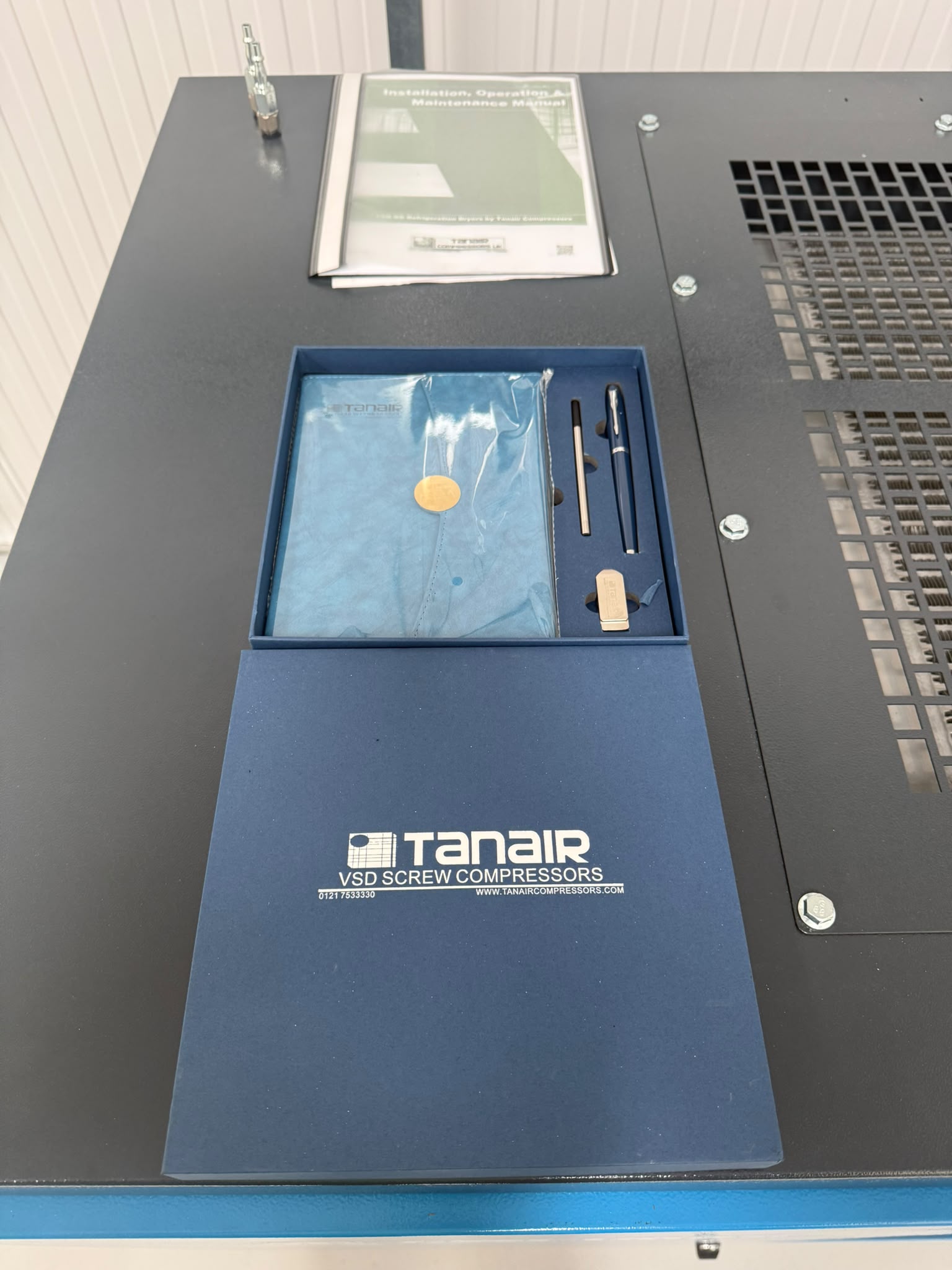
Operating information and supporting materials supplied at handover.
Watch the KUT Machinery Installation
These short videos show the Tanair equipment, showroom environment and completed installation in greater detail.
Common Mistakes When Selecting a Laser Cutting Compressor
CNC Laser Compressor Specification Checklist
Before requesting a quotation, gather as much of the following information as possible.
- Laser manufacturer and model
- Required airflow at operating pressure
- Required air-quality or treatment specification
- Expected operating hours and shift pattern
- Whether compressed air is used as an assist gas
- Other machinery connected to the same system
- Distance from compressor location to point of use
- Available electrical supply
- Ventilation and plant-room conditions
- Planned future machinery or production expansion
Do not have all the information? Send our team the machinery specification or manual and we can help identify the details needed to assess the compressed air system.
Related Equipment and Services
Explore the equipment and services used to create professionally engineered compressed air installations for manufacturing machinery.
Frequently Asked Questions
What size air compressor do I need for a CNC laser cutter?
The correct size depends on the laser manufacturer's required airflow, operating pressure, duty cycle and any other equipment connected to the same system. Select using delivered airflow at the required pressure rather than motor kW alone.
Can compressed air be used as an assist gas for laser cutting?
Some laser cutting systems and applications can use compressed air as an assist gas. The required pressure, airflow and air quality vary, so approval and specification must come from the machinery manufacturer.
Does a laser cutting machine need a refrigeration dryer?
Where clean, dry compressed air is required, a correctly sized refrigeration dryer can reduce moisture before the air reaches the machine. The required treatment level should be confirmed against the manufacturer's specification.
Why is compressed air filtration important for CNC machinery?
Filtration can reduce particles, water aerosols and oil aerosols within the compressed air supply. This helps protect downstream pneumatic equipment and maintain the required air quality.
Is a variable speed compressor better for a laser cutter?
A variable speed compressor can be beneficial where demand changes throughout the working day. It adjusts output more closely to actual usage and can reduce unnecessary off-load running.
Can one compressor run more than one laser cutting machine?
Potentially, but the system must be sized for simultaneous demand, required pressure, treatment equipment and other connected users. Diversity should only be applied where operating patterns are properly understood.
What does the air receiver do?
The receiver stores compressed air and acts as a buffer. It can support short demand peaks, stabilise pressure and reduce rapid compressor cycling.
Does compressed air pipework affect laser performance?
Yes. Undersized, leaking or restrictive pipework can create pressure loss between the compressor and machinery. Pipe diameter and layout should be considered during system design.
Can an existing workshop compressor be used?
It may be suitable if it can deliver the required airflow, pressure, duty and air quality while also supporting all existing equipment. The complete system should be assessed before connecting the new machinery.
Can Compressed Air Systems UK install the full system?
Yes. We can supply compressors, dryers, filtration, air receivers, condensate drainage and pipework, followed by installation, commissioning and customer handover.
Do you provide servicing after installation?
Yes. We provide planned servicing, replacement parts, technical support and 24/7 emergency breakdown assistance throughout the working life of the equipment.
Do you install laser cutting compressor systems nationwide?
Yes. Compressed Air Systems UK provides equipment specification, installation and service support for customers across the UK.
Need help specifying compressed air for your laser cutter?
Send our team the machinery model, airflow requirement, operating pressure and expected usage. We can help specify the compressor, dryer, filtration, storage and pipework required for your application.