
How Much Compressed Air Does a CNC Laser Cutter Need?
There is no single CFM figure for every CNC or fibre laser. The correct compressor depends on the machine's delivered airflow, pressure, whether compressed air is used as an approved assist gas, production hours, other connected users and the required air quality.
The Short Answer
The airflow required by a CNC laser cutter can vary considerably. Some machines use compressed air only for pneumatic controls or protective functions. Others are approved to use compressed air as a cutting assist gas, which can create a much higher airflow and pressure requirement.
Start with the exact laser manufacturer's specification. Confirm the required airflow, operating pressure, duty cycle and air-quality requirement before selecting the compressor.
What Is Compressed Air Used for on a Laser Cutter?
Why We Do Not Recommend a Generic “Typical CFM” Table
Broad planning bands such as 15–30 CFM, 30–60 CFM or 60–120+ CFM are too general for final compressor selection and can encourage sizing from a category rather than the actual machine data.
A safer and more useful approach is to use the manufacturer's stated consumption at the specified pressure and then build the system around that requirement.
- Laser manufacturer and exact model
- Airflow required during cutting
- Airflow required for pneumatic functions
- Required pressure for each function
- Whether cutting-air and pneumatic-air demands overlap
- Required air quality or pressure dew point
CFM Must Be Compared at the Correct Pressure
Compressor airflow is commonly quoted as CFM, l/min or m³/min. For selection, use the compressor's delivered or free-air output at the pressure the system actually needs.
A compressor's usable airflow can change with pressure, so a CFM figure quoted at one pressure should not automatically be compared with a laser requirement at another.
Machine Side
- Required point-of-use pressure
- Required airflow at that pressure
- Peak and sustained demand
Compressor Side
- Free air delivery at the selected pressure
- Available operating-pressure range
- Minimum and maximum VSD output where relevant
Pressure at the Compressor Is Not Pressure at the Laser
Pressure is lost as air passes through treatment equipment and the distribution system. The installation should therefore be designed around the pressure required at the laser while avoiding an unnecessarily high compressor setting.
Duty Cycle and Production Hours Change the Answer
Intermittent Production
If cutting demand rises and falls, compressor control and receiver storage can help the system respond to short changes in airflow.
Continuous Production
If the laser consumes high airflow for long periods, the compressor must be able to sustain that demand. Stored air cannot replace continuous compressor capacity.
Long operating hours also make energy use, ventilation, service intervals and system pressure more commercially important.
How to Calculate Total Workshop Demand
| Step | What to Establish | Why It Matters |
|---|---|---|
| 1. Laser demand | Required flow and pressure from the manufacturer. | Creates the core load for the system. |
| 2. Other users | Press brakes, automation, tools and additional CNC equipment. | Prevents the laser being sized in isolation. |
| 3. Simultaneous demand | Which users can genuinely operate together. | Establishes realistic peak flow. |
| 4. System pressure loss | Dryer, filters, pipework, valves and hoses. | Ensures required pressure reaches the laser. |
| 5. Future demand | Known machinery additions or shift changes. | Reduces the risk of early replacement without uncontrolled oversizing. |
Can One Compressor Run Two Laser Cutters?
Yes, if the complete simultaneous demand can be met at the required pressure. If both lasers can operate at full compressed-air demand at the same time, the compressor system generally needs to support the combined load plus other realistic users.
If operating schedules prevent full overlap, a diversity allowance may be reasonable — but only where it is based on actual production behaviour rather than assumption.
- Combined maximum and average airflow
- Highest required point-of-use pressure
- Simultaneous cutting periods
- Press brakes, automation and workshop tools
- Receiver capacity and distribution volume
- Future machinery plans
Air Quality Is as Important as Air Quantity
The correct air-treatment package depends on what the laser manufacturer requires and how compressed air is used within the machine.
Drying
A refrigeration dryer can suit many workshop applications, but it should only be selected where its achievable pressure dew point meets the laser requirement. Higher-grade drying may be needed for a more demanding specification.
Filtration
Filters can reduce particles, water aerosols and oil aerosols. Activated-carbon treatment may be needed where oil vapour limits are particularly strict.
What Does the Air Receiver Do?
A receiver provides stored compressed air and system volume. It can help with short demand peaks, pressure stability and compressor control.
When Variable Speed Can Suit Laser Cutting
A VSD compressor can be a good fit where total compressed-air demand changes as the laser starts, stops, pauses between jobs or shares the system with other intermittent equipment.
- Motor speed follows changing system demand within the compressor's operating range.
- Unnecessary unloaded operation can be reduced where demand genuinely fluctuates.
- Pressure can often be controlled over a narrower band.
- The compressor still needs to be correctly sized at both minimum and maximum demand.
Real Installation Example: KUT Machinery
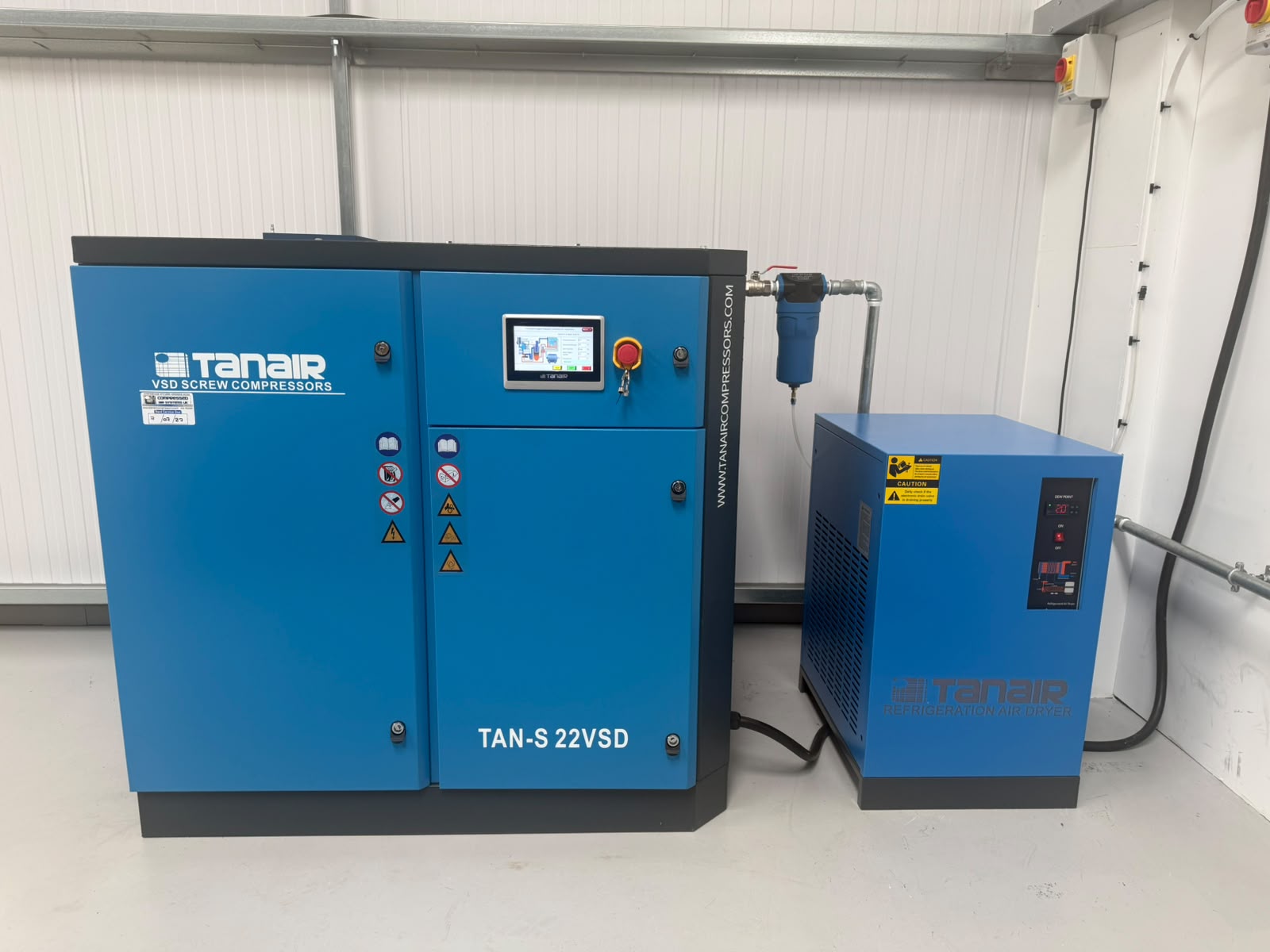
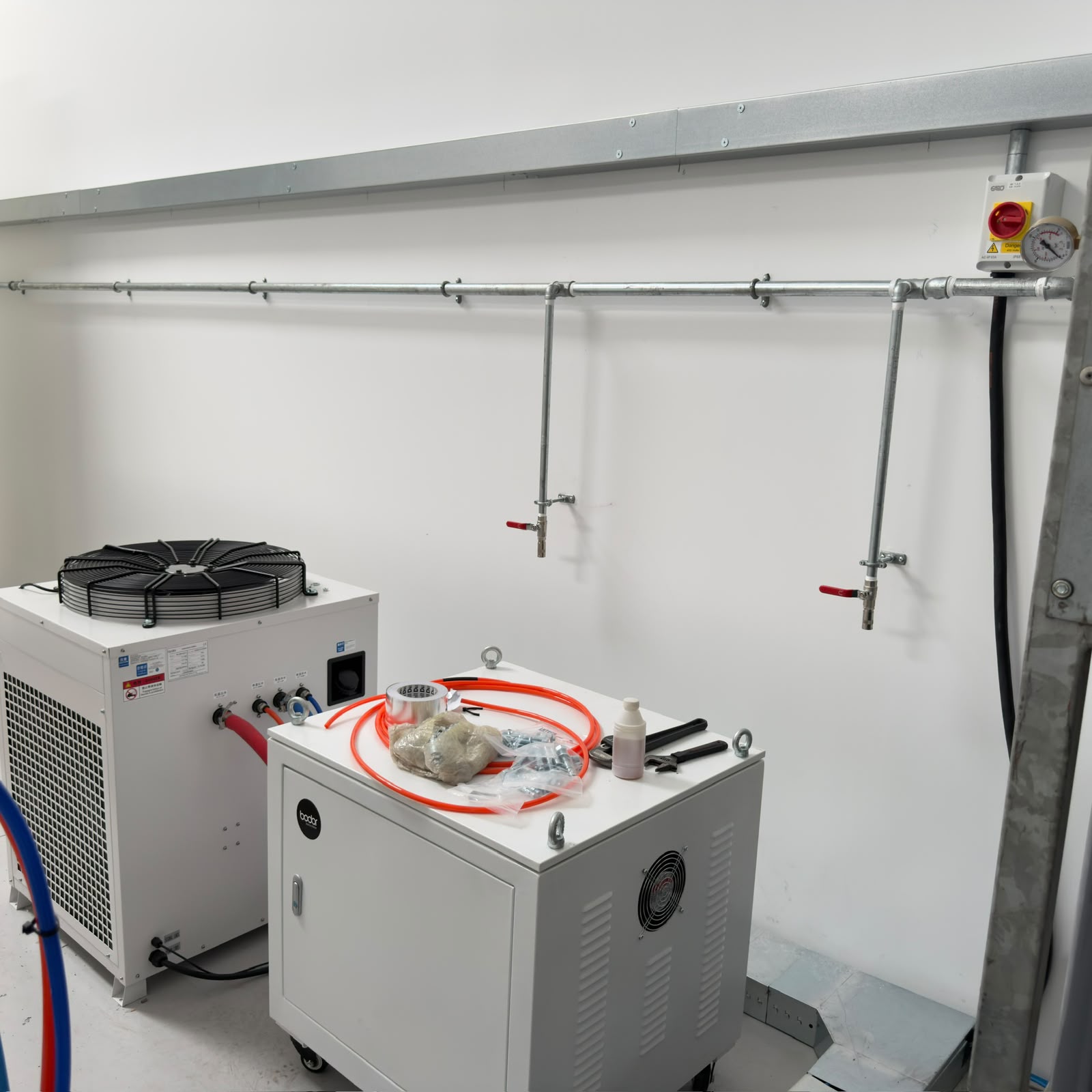
Compressed Air Systems UK supplied, installed and commissioned a coordinated Tanair compressed-air system for the KUT Machinery showroom in Kidderminster, supporting laser cutting, press-brake, deburring and associated manufacturing equipment.
- Tanair TAN-S 22VSD compressor
- Current published compressor output: 112 CFM / 3.2 m³/min at up to 10 bar
- TAN-RD-36 refrigeration dryer
- High-efficiency filtration
- 500-litre vertical air receiver
- Compressed-air distribution pipework
- Testing and commissioning
- Customer handover and support
The useful lesson is not that every laser cutter needs this exact package. The system was selected around the combined showroom demand, air quality, pressure, storage and distribution requirements.
Common CNC Laser Compressor Sizing Errors
Information We Need to Size the System
- Laser manufacturer and exact model
- Laser power
- Required airflow
- Required operating pressure
- Whether compressed air is used as an assist gas
- Required air-quality specification
- Daily production hours and shift pattern
- Other connected machinery
- Expected simultaneous demand
- Distance from compressor to laser
- Available electrical supply
- Future machinery plans
CNC Laser Compressed-Air FAQs
How many CFM does a CNC laser cutter need?
There is no universal figure. Use the exact machine manufacturer's airflow requirement at the specified pressure and confirm whether compressed air is used only for pneumatics or also as an approved cutting assist gas.
What pressure does a fibre laser need?
Pressure varies by machine and application. Pneumatic functions may use conventional workshop pressure while approved compressed-air assist cutting can require substantially more. Always use the manufacturer's specification.
Can I use generic 15–30, 30–60 or 60–120 CFM ranges to size a laser?
No. Those are too broad for final compressor selection. The exact laser's stated demand should be used instead.
Can I size the compressor using motor kW?
No. Compare delivered or free-air output at the required pressure. Similar compressor motor ratings can produce different airflow.
Does a CNC laser need a dryer?
Where the machine requires dry compressed air, the drying technology should be selected from the required pressure dew point. A refrigeration dryer is suitable only where its achievable dew point meets the specification.
Can one compressor run two laser cutters?
Potentially, provided the compressor, receiver, treatment and pipework can support the realistic combined simultaneous airflow at the highest required pressure.
Can a bigger receiver let me use a smaller compressor?
A receiver can support short peaks but cannot indefinitely compensate for compressor output below sustained laser demand.
Is VSD better for a laser-cutting workshop?
It can be where total demand changes materially as lasers and other equipment cycle, but a VSD still needs to be correctly sized for the site's minimum and maximum airflow.
Can Compressed Air Systems UK specify the full CNC system?
Yes. We can assess compressor capacity, dryer and filtration, receiver storage, pipework, electrical supply and installation requirements as one coordinated system.
Need the Compressor Sized for Your Laser Cutter?
Send us the laser model, required airflow, operating pressure, whether compressed air is used as an assist gas and your production hours. We can help size the complete system rather than simply matching a compressor motor rating.