Industry leaders since 1992
Fast delivery
Trade counter collection
Experts available 24/7
Read our Trustpilot reviews
Reciprocating Compressor Lubrication

Piston Air Compressor Lubricant

Mineral and specialist compressor oils for compatible oil-lubricated piston and reciprocating air compressors, with options for routine servicing and selected food-grade applications.

Oil for Reciprocating & Piston Air Compressors

Oil-lubricated piston compressors rely on the correct compressor lubricant to protect bearings, cylinders and other moving components while operating under repeated compression cycles.

Compressor oil should be selected using the compressor make, model, lubricant specification and service requirements. Do not substitute engine oil or another compressor lubricant simply because the viscosity appears similar.

Piston Compressors
Reciprocating Compressors
Mineral Oil Options
Food-Grade Option
UK Technical Support
Piston Compressor Oil Range

Piston & Reciprocating Compressor Lubricants

Choose the lubricant that matches the compressor manufacturer's specification, service requirement and application. Do not mix different compressor oils unless compatibility is confirmed.

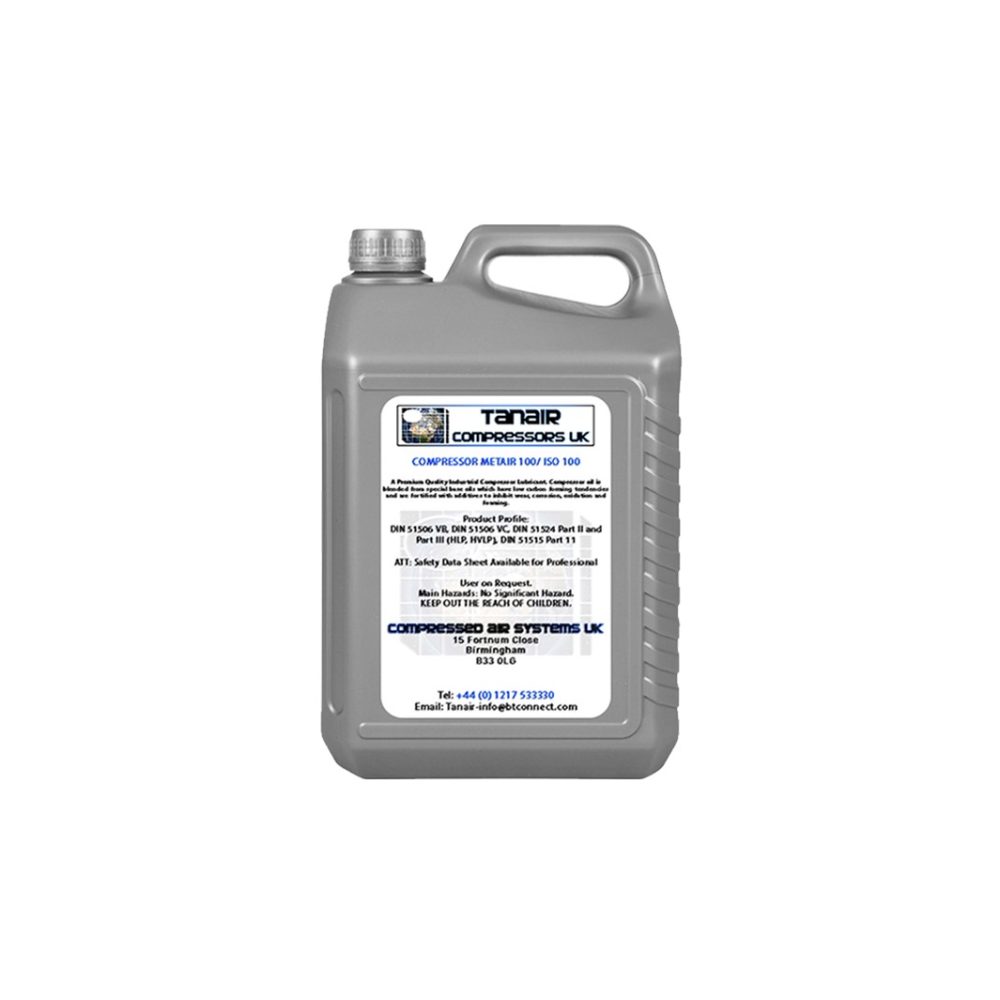
Tanair Metair 100 Piston Compressor Oil

Metair 100 is a mineral compressor lubricant for compatible reciprocating and piston air compressors. The current product specification identifies it as an ISO VG 100 lubricant supplied in a 5 litre container.

The product data also identifies the DIN 51506 VDL compressor-oil specification. Always confirm that these requirements match the particular compressor before use.

Metair 100 Specification Typical Value
Product Type Mineral piston / reciprocating compressor lubricant
Kinematic Viscosity @ 40°C 100 cSt
Viscosity Index >95
Specific Gravity @ 15.6°C 0.888
Flash Point >225°C
Pour Point -10°C
Specification DIN 51506 VDL
Pack Size 5 Litres

Why Piston Compressors Need the Correct Oil

A piston compressor repeatedly compresses air while its crank, bearings, connecting rods and other moving components operate continuously within the pump.

  • Provides lubrication between moving components
  • Helps reduce friction and wear
  • Supports heat management within the compressor pump
  • Helps protect internal surfaces against corrosion
  • Helps control oxidation and deposit formation when the correct oil is used
  • Supports reliable operation between scheduled services

How to Choose Piston Compressor Oil

Compressor Make & Model

Use the full compressor or pump model as the starting point for lubricant selection.

Required Viscosity

Confirm the viscosity grade specified by the compressor manufacturer rather than choosing by appearance.

Mineral or Specialist Oil

Check whether the compressor requires mineral oil, synthetic lubricant or another specified formulation.

Existing Lubricant

Identify the lubricant already installed before topping up or changing to another product.

Food-Grade Requirement

If a food-grade lubricant is required, confirm the exact lubricant approval and compressor compatibility needed by the application.

Service Interval

Follow the compressor manufacturer's operating-hour and calendar-based oil-change requirements.

Never choose compressor oil solely by viscosity. Oils with similar viscosity can use different base oils, additive packages and performance specifications.

Can Engine Oil Be Used in a Piston Air Compressor?

Engine oil should not automatically be used in a piston compressor. Compressor lubricants are selected for the operating conditions and requirements of the compressor pump.

Only use an automotive or engine lubricant where the compressor manufacturer specifically approves that oil type and specification.

If your compressor is petrol or diesel engine-driven, remember that the engine and compressor pump are separate lubrication systems and may require completely different oils.

Food-Grade Piston Compressor Lubricant

Some food, beverage, pharmaceutical and packaging installations may require a food-grade lubricant where the risk assessment and system specification call for it.

The LUB-FGL-RECIP product is identified as a reciprocating food-grade compressor lubricant in a 1 litre pack.

“Food grade” does not by itself confirm that a complete compressed-air system is suitable for product contact. Required lubricant approvals, air treatment and final compressed-air quality should be confirmed for the particular process.

Can Piston Compressor Oils Be Mixed?

Different compressor lubricants should not be mixed unless compatibility has been confirmed.

Changing between different base oils or additive systems can affect lubricant performance and may require a complete drain, cleaning procedure or other service work.

If you do not know which oil is already in the compressor, identify the existing product before topping it up.

Changing Piston Compressor Oil

Oil-change procedures vary between compressor pumps. Follow the equipment manufacturer's servicing instructions and use the correct oil quantity and checking method.

  • Electrically isolate the compressor before servicing
  • Allow hot equipment and oil to cool safely before work
  • Depressurise the system where required
  • Use clean drain and filling equipment
  • Replace oil with the specified grade and quantity
  • Do not overfill the crankcase
  • Check for leakage after returning the machine to service
  • Dispose of used compressor oil through an appropriate waste route

Checking Piston Compressor Oil Level

Oil-lubricated compressor pumps commonly use a sight glass, dipstick or another level indicator. Follow the specific machine procedure when checking the oil.

Low Oil

Operating with insufficient lubricant can increase wear, temperature and the risk of pump damage.

Overfilling

Excess oil can also cause operating problems and increased oil carryover. Fill only to the specified level.

Why Is My Compressor Oil Level Dropping?

If a piston compressor repeatedly requires topping up, investigate the reason rather than treating continual oil loss as normal.

  • External oil leakage
  • Loose drain or filler components
  • Worn seals or gaskets
  • Excessive oil carryover
  • Internal compressor-pump wear
  • Incorrect oil level or filling procedure
  • Unsuitable lubricant for the application

Compressor Oil Storage & Handling

  • Keep lubricant containers sealed when not in use
  • Protect oil from dirt, moisture and contamination
  • Keep different oil types clearly identified
  • Use clean funnels and transfer equipment
  • Do not return drained lubricant to a clean container
  • Follow the lubricant's storage and safety information

Need Help Identifying the Correct Piston Compressor Oil?

If you are unsure which lubricant your compressor requires, send us the machine and current oil information.

  • Compressor manufacturer
  • Compressor model
  • Compressor serial number
  • Pump model where shown separately
  • Existing lubricant name or part number
  • Required viscosity grade
  • Current running hours
  • Last service date where known
  • Any food-grade requirement
  • Clear photograph of the compressor data plate
Call 0121 753 3330 for piston compressor lubricant identification and servicing support.

Need a Different Compressor Lubricant?

Rotary screw and rotary vane compressors have different lubricant requirements from conventional piston compressors.

Piston Compressor Oil FAQs

What oil should I use in a piston air compressor?

Use the lubricant grade and specification stated by the compressor manufacturer. Match the compressor model, viscosity and lubricant type before ordering.

What is Metair 100 compressor oil?

Metair 100 is an ISO VG 100 mineral compressor lubricant supplied in a 5 litre pack for compatible reciprocating and piston air compressors.

What is Recip-Fluid Plus?

Recip-Fluid Plus is a mineral compressor lubricant supplied in a 1 litre pack for compatible reciprocating and piston compressor service applications.

Can I use engine oil in a piston compressor?

Not automatically. Only use engine oil where the compressor manufacturer specifically approves the required engine-oil grade and specification.

Can I mix different piston compressor oils?

Not unless compatibility has been confirmed. Different base oils and additive packages may be unsuitable for mixing.

What is food-grade piston compressor oil?

It is a lubricant intended for compatible reciprocating compressor applications where a specified food-grade lubricant is required. The exact lubricant approval needed by the application should still be confirmed.

How often should piston compressor oil be changed?

Follow the compressor manufacturer's operating-hour and calendar service intervals. Harsh operating conditions may require more frequent maintenance.

Why does my piston compressor keep losing oil?

Possible causes include external leakage, worn seals, excessive oil carryover, internal pump wear or an incorrect filling procedure.

Can Compressed Air Systems UK help identify the correct compressor oil?

Yes. Provide the compressor make, model, serial number and existing lubricant details and our team can help identify the appropriate option.

Not Sure Which Piston Compressor Oil You Need?

Send us the compressor make, model, serial number and details of the oil currently in use and our team can help identify the correct lubricant before you order.

Call 0121 753 3330

Industries We Support

Energy, Process & Heavy Industry
Food & Beverage
Automotive & Transport
Manufacturing & Engineering
And many more — talk to us for help sizing the right solution for your application.

Support & Aftercare

WarrantyFull peace of mind guaranteed on all workshop compressors.
UK installation availableProfessional on-site setup by our experienced technicians.
Full Aftermarket SupportComprehensive spares and repairs always ready to go.
UK Based SupportLocal experts just a phone call away for any assistance.
Genuine Service PartsOnly original, high-quality service parts for your machine.
Expert Air AdviceLeverage our 30+ years of technical compressed air knowledge.
Scroll to Top