Why Direct Drive and VSD Are Different Features
“Direct drive” and “variable speed” describe two separate parts of the compressor design. Direct drive refers to how the motor connects to the compression element, while VSD refers to how motor speed is controlled as air demand changes.
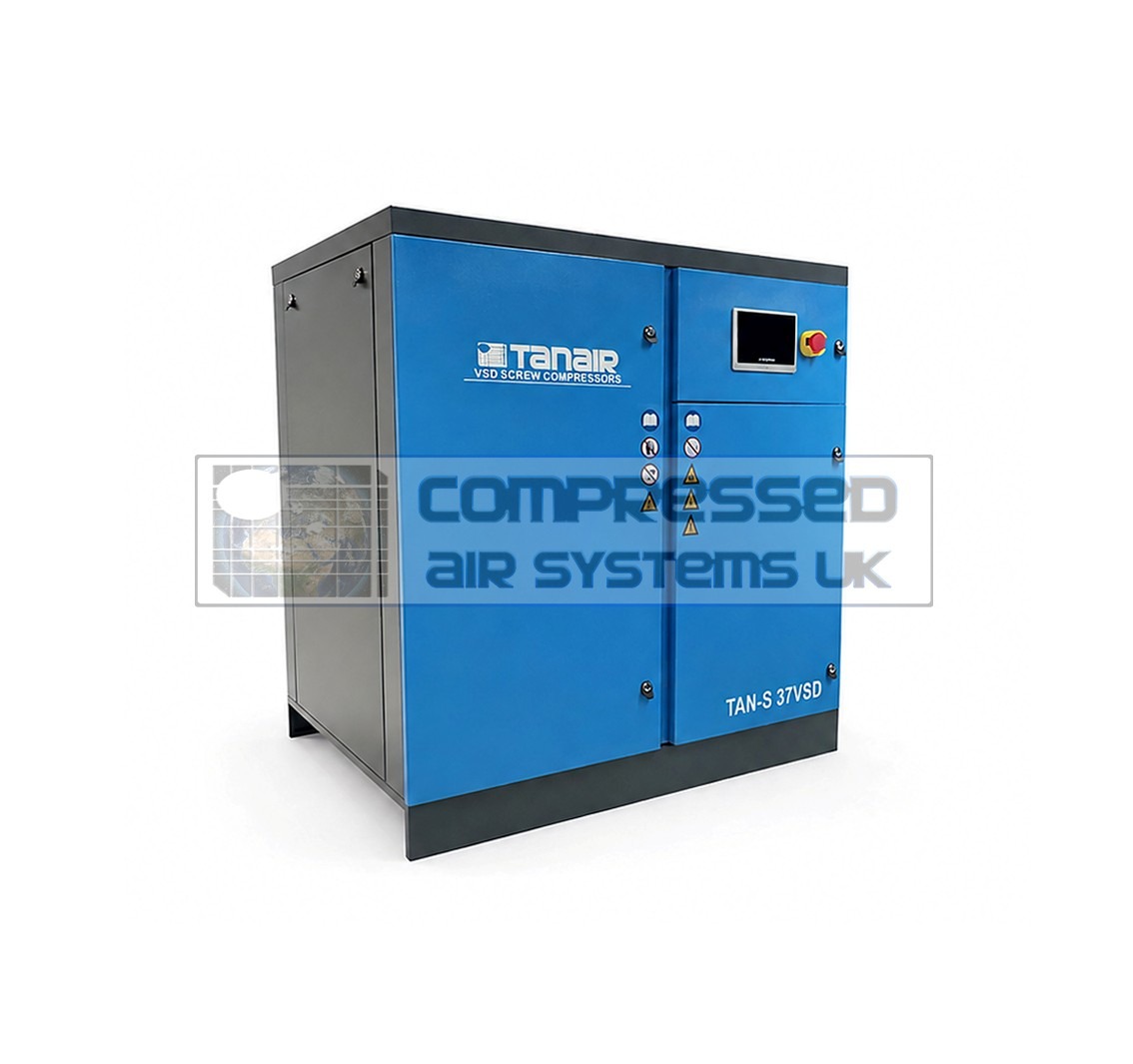
Tanair's current TAN-S PM VSD range combines both: a direct-drive arrangement with permanent-magnet variable-speed control. The absence of drive belts removes belt inspection, tension adjustment and belt replacement from the routine drive-system maintenance schedule.
What it does not mean: direct drive does not make the compressor maintenance-free, and VSD does not guarantee a fixed percentage energy saving. Filters, oil, separators, coolers, valves, drains and other service items still need proper maintenance.
How Variable-Speed Control Works
A variable-speed screw compressor changes motor speed to follow compressed-air demand within its operating range. When demand falls, the compressor can reduce speed instead of repeatedly operating at full output and then spending long periods unloaded.
Where VSD Can Help
- Air demand changes materially during the working day
- Several users or production processes start and stop
- An existing fixed-speed compressor spends significant time unloaded
- Pressure is being maintained across a changing load profile
Where VSD Is Not Automatically Better
- Demand is consistently high and stable
- The proposed compressor is substantially oversized
- The machine would spend excessive time below its effective operating range
- System leaks or high pressure are the real source of wasted energy
Direct Drive: What “No Belts” Actually Changes
No Belt Tensioning
There are no drive belts to inspect and retension as part of the transmission system.
No Belt Replacement
Routine replacement of worn drive belts is removed from the maintenance schedule.
Fewer Transmission Components
The motor-to-air-end arrangement is mechanically simpler than a belt-driven transmission.
Avoid universal efficiency-loss figures: belt-drive losses vary with drive design, belt type, alignment, loading and maintenance condition. It is safer to say direct drive removes the belt transmission stage than to claim every belt-driven compressor loses a fixed 4–11%.
The Current Tanair TAN-S VSD Range
The current range spans 5.5 kW to 22 kW and is designed around 415V three-phase industrial compressed-air systems. The models below are retained as the core product routes for this guide.
TAN-S-5.5VSD
5.5 kW · 19 CFM · 10 bar · 415V three phase · direct-drive PM VSD.
View 5.5 kW model →
TAN-S-7.5VSD
7.5 kW · 32 CFM · 10 bar · 415V three phase · direct-drive PM VSD.
View 7.5 kW model →
TAN-S-11VSD
11 kW · 46 CFM · 10 bar · 415V three phase · direct-drive PM VSD.
View 11 kW model →
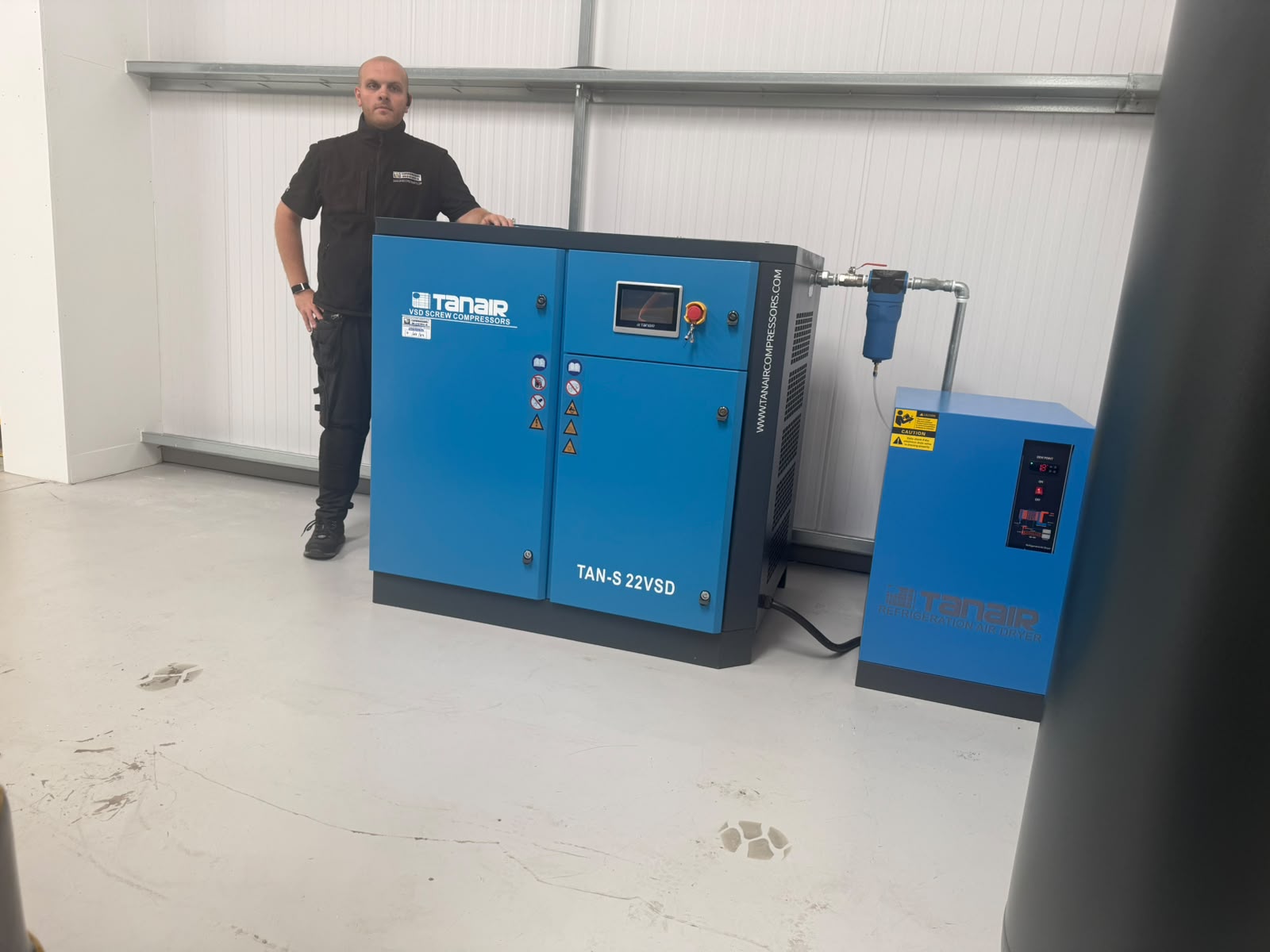
TAN-S-22VSD
22 kW · 112 CFM · 10 bar · 415V three phase · direct-drive PM VSD.
View 22 kW model →
Do VSD Compressors Really Save Energy?
They can, but the answer depends on the site. The strongest VSD opportunities are usually systems with genuinely variable demand, significant annual operating hours and a fixed-speed compressor that spends meaningful time unloaded or cycling between load states.
A fixed “up to 35%” figure may be useful as a product marketing ceiling, but it should not be presented as a guaranteed outcome for every installation. Actual energy use depends on the load profile, pressure setting, compressor sizing, system leakage and controls.
| Factor | Why It Affects Savings |
|---|
| Load Profile | VSD has more opportunity where air demand rises and falls rather than remaining near full output. |
| Operating Hours | Energy improvements have more financial value on machines that run for substantial annual hours. |
| Pressure Setting | Running at unnecessarily high pressure can increase energy demand regardless of drive type. |
| Leaks & Artificial Demand | A VSD compressor will still supply wasted air if the system has significant leakage or excessive pressure. |
| Correct Sizing | An oversized VSD compressor is not automatically efficient simply because it can slow down. |
Lower Maintenance Does Not Mean No Maintenance
Removing belts simplifies one part of the drive system, but an oil-injected rotary screw compressor still has routine service requirements. The exact schedule depends on operating hours, environment and the manufacturer's service instructions.
Typical Service Areas
- Compressor oil
- Oil filter
- Air intake filter
- Oil separator element
- Coolers and ventilation path
System Items Matter Too
- Automatic drains
- Dryer servicing
- Downstream filter elements
- Receiver inspection requirements
- Condensate-management equipment
Which Tanair VSD Size Is Right?
Choose from required delivered airflow at the genuine working pressure, then confirm the minimum/average/peak demand and operating hours. Motor kW alone is not enough to size the compressor.
19 CFMSuitable where the real simultaneous demand fits within the 5.5 kW model's output and operating range.
32 CFMA step up for workshops or light industrial systems requiring more variable compressed-air capacity.
46 CFMFor higher-demand applications where the 11 kW output matches the site's measured or calculated requirement.
112 CFMFor substantially larger industrial demand requiring a 22 kW compressor and suitably designed electrical and air-treatment system.
Receiver SizeSelect the receiver around demand pattern and system behaviour; receiver litres do not determine compressor CFM.
Air TreatmentDryer and filtration capacity should be selected from actual airflow, operating conditions and required air quality.
Complete VSD Packages
A floor-mounted compressor still needs the rest of the compressed-air system to be considered. Tanair also offers packaged arrangements combining VSD compressors with receivers, refrigerated dryers, filtration and condensate treatment.
Electrical and Installation Requirements
The TAN-S VSD range is 415V three phase. The supply, protective device, cable, local isolation and installation should be checked against the exact compressor's requirements by competent personnel.
- Confirm the exact model's full-load current and manufacturer electrical requirements.
- Provide suitable local isolation and electrical protection.
- Maintain adequate ventilation and service clearance around the compressor.
- Use correctly sized pipework to avoid unnecessary pressure loss.
- Provide separate electrical supplies where required for standalone dryers or ancillary equipment.
When Fixed Speed May Still Be the Better Choice
VSD should not be treated as the automatic upgrade path for every site. If demand is steady for long periods and the compressor can operate efficiently while loaded, a correctly sized fixed-speed machine may be commercially and technically appropriate.
The best comparison uses the site's actual demand profile rather than choosing by technology label alone.
For an existing compressor: operating-hour data, loaded/unloaded hours, pressure settings and measured airflow can provide a much stronger basis for comparison than estimating savings from motor kW alone.
Direct-Drive VSD Compressor FAQs
What is a direct-drive VSD compressor?
It is a compressor where the motor connects to the compression element without a belt transmission and a variable-speed drive adjusts motor speed according to compressed-air demand.
Does direct drive eliminate all maintenance?
No. It removes belt-related inspection, tensioning and replacement, but the compressor still requires servicing of oil, filters, separator elements, coolers and other components according to the manufacturer's schedule.
Do Tanair VSD compressors save 35% energy?
They may reduce energy use substantially in suitable variable-demand applications, but a 35% figure should not be treated as guaranteed. Actual savings depend on load profile, pressure, operating hours, system leakage and correct sizing.
Is direct drive always more efficient than belt drive?
Direct drive removes belt transmission losses, but the total efficiency difference depends on the complete compressor design and operating point. Avoid assuming every belt-driven compressor loses the same fixed percentage.
When is VSD most useful?
VSD is generally most useful where air demand changes materially during the working day and a fixed-speed compressor would otherwise spend meaningful time unloaded or cycling between load states.
When might fixed speed be better?
Where demand is stable and consistently high, a correctly sized fixed-speed compressor may be a practical and efficient choice. The site's demand profile should guide the decision.
What sizes are available in the Tanair TAN-S VSD range?
The current range includes 5.5 kW / 19 CFM, 7.5 kW / 32 CFM, 11 kW / 46 CFM and 22 kW / 112 CFM models at up to 10 bar.
Can you help compare my existing compressor with VSD?
Yes. Provide the existing compressor make/model, operating hours, working pressure, loaded/unloaded behaviour and your site's airflow demand. The more real operating data available, the more meaningful the comparison can be.
Is Direct-Drive VSD Right for Your Site?
Tell us your required CFM, working pressure, operating hours and whether demand stays steady or changes during the day. We can help compare the current Tanair VSD models and the air-treatment equipment needed around them.
Compressed Air Systems UK · Unit 15, Fortnum Close, Birmingham, B33 0LG