
Air Compressor for CNC Laser Cutting Machines: Complete UK Selection Guide
An incorrectly specified air compressor can cause pressure drops, moisture damage to laser optics and costly production stoppages. Select the system from real airflow, pressure, duty cycle and air-quality requirements — then size the receiver, dryer, filtration and pipework as one coordinated package.
Why CNC and Fibre Laser Cutting Machines Need Compressed Air
Choosing the right air compressor for CNC laser cutting machines is essential for reliable performance, clean cuts and long-term equipment protection. In UK manufacturing workshops the compressed-air system must deliver stable pressure, adequate airflow and high-quality dry air while supporting pneumatic functions and, in many cases, assist-gas applications.
Compressed air supports several critical functions:
- Pneumatic operation of valves, cylinders, loading systems and automation
- Assist air for certain cutting processes (subject to manufacturer approval)
- Protection of sensitive components by supplying clean, dry air
- Cooling and debris removal around the cutting head and optics
Airflow, Pressure and Duty Cycle: The Three Essential Requirements
Compressor selection always starts with the machinery specification, not the compressor motor size.
Why Compressor Selection Cannot Be Based on kW Alone
Motor kW is only one part of the picture. Delivered airflow at the required pressure, duty cycle, other workshop users and system losses all determine whether the installation will perform reliably.
| Factor | Why It Matters | Risk if Ignored |
|---|---|---|
| Delivered airflow | Must meet total demand at the required pressure | Pressure loss and machine interruptions |
| Operating pressure | Higher pressure reduces available airflow | Incorrect sizing and higher energy costs |
| Duty cycle | Matches operating hours and load pattern | Overheating or premature wear |
| Other equipment | Additional tools and machines share the air supply | Capacity shortfalls during peaks |
| Future expansion | Planned growth changes airflow needs | Costly later upgrades |
| Pressure losses | Dryers, filters and pipework create resistance | Adequate compressor pressure but low at the machine |
Why Clean, Dry Compressed Air Matters
Moisture, particles and oil aerosols can damage laser optics, valves and pneumatic components, leading to poor cut quality, increased maintenance and unplanned downtime.
- Moisture collects in pipework and expands at the nozzle
- Particles contaminate valves and sensitive components
- Oil aerosols are unsuitable for many laser applications
- Corroded pipework introduces further contamination
Refrigeration Air Dryers
A correctly sized refrigeration dryer cools the air so moisture condenses and is removed before distribution. Size the dryer for airflow, inlet temperature, ambient conditions and operating pressure.
Compressed Air Filtration
Multi-stage filtration removes solid particles, water aerosols and oil aerosols to the standard required by the laser manufacturer.
Why Variable Speed Compressors Suit Changing Manufacturing Demand
Production demand fluctuates as machines start and stop. A variable-speed drive (VSD) compressor adjusts motor speed and output to match actual demand.
Key Benefits of VSD
- Output follows demand more closely
- More stable system pressure
- Reduced unnecessary off-load running and lower energy use
When Fixed Speed Can Still Be Right
Where airflow demand remains high and stable for long periods, a correctly sized fixed-speed compressor can be an efficient and reliable choice.
What Does the Air Receiver Do?
An air receiver stores capacity, helps absorb short peaks in demand, stabilises pressure and reduces rapid compressor cycling. Correct sizing depends on compressor output, pressure, demand pattern and machinery usage. It should never be used to compensate for an undersized compressor.
Compressed Air Pipework for CNC Workshops
Even a correctly sized compressor underperforms if pipework is restrictive or poorly designed. Key points include:
- Correct pipe diameter to limit pressure drop
- Efficient routing between compressor and machinery
- Isolation points for maintenance
- Drainage and condensate management
- Allowance for future branch connections
Installing pipework at the same time as the compressor allows the full system to be assessed before production starts.
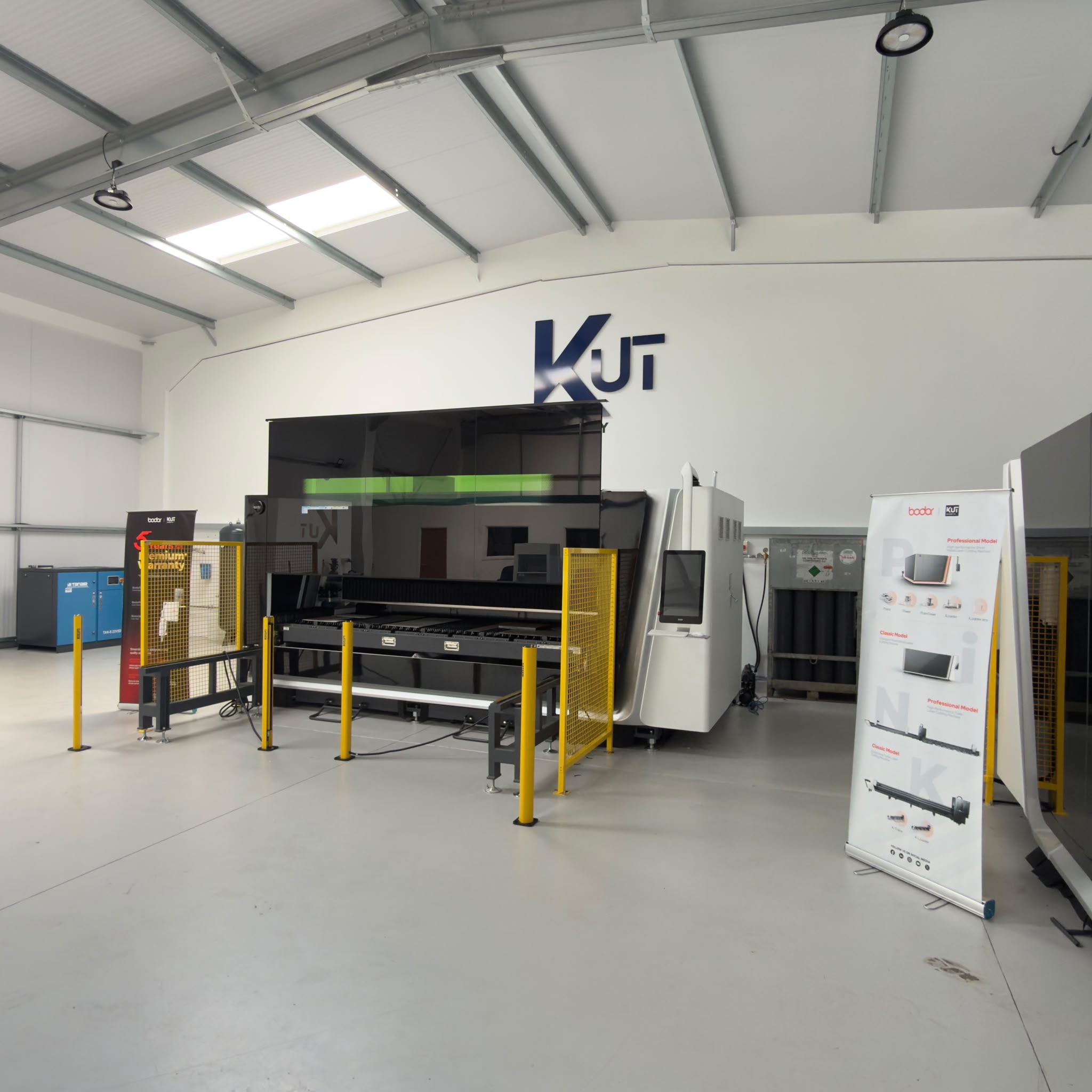
Real-World Example: KUT Machinery Ltd
Compressed Air Systems UK supplied, installed and commissioned a complete Tanair system for the KUT Machinery showroom in Kidderminster. The package included:
- Tanair TAN-S 22VSD compressor (up to approximately 113 CFM)
- TAN-RD-36 refrigeration dryer
- High-efficiency filtration
- 500-litre vertical receiver
- Distribution pipework
- Full testing, commissioning and customer handover
This installation demonstrates how capacity, drying, filtration, storage and pipework can be planned around modern laser and manufacturing machinery — not simply by choosing a motor size.
Common Mistakes When Selecting a Laser Cutting Compressor
- Choosing by motor kW alone
- Ignoring air-treatment requirements
- Using undersized or restrictive pipework
- Forgetting other workshop equipment on the same system
- No allowance for future expansion
- Skipping proper commissioning and leak checks
CNC Laser Compressor Specification Checklist
Gather the following before requesting a quotation:
- Laser manufacturer and exact model
- Required airflow at operating pressure
- Air quality or treatment specification
- Expected operating hours and shift pattern
- Whether compressed air is used as assist gas
- Other machinery sharing the air system
- Site power supply and available space
- Future expansion plans
FAQ: Air Compressor for CNC Laser Cutting
What pressure does an air compressor for CNC laser cutting need?
Many assist-air applications require 10–16 bar at the nozzle after system losses. Always confirm the exact figure with the laser manufacturer, as requirements vary by model and process.
Can I use a standard workshop compressor for a fibre laser?
Standard 8–10 bar fixed-speed units are often inadequate for high-pressure assist air and continuous duty. A properly sized system with drying and filtration is usually required.
Do I need an oil-free compressor for laser cutting?
High-quality treated air is essential to protect optics. Oil-lubricated compressors with suitable filtration can be acceptable if the air quality meets the manufacturer’s specification; many users prefer oil-free or heavily filtered systems.
Why is a refrigeration dryer important?
Moisture can damage laser optics and affect cut quality. A correctly sized dryer removes water vapour before the air reaches the machine.
How do I size a compressor for my laser power?
Base the calculation on the laser manufacturer’s airflow and pressure data, add a design margin for losses and other equipment, and consider duty cycle and future growth. Motor kW alone is not sufficient.
Where can I get a complete compressed air system for CNC laser cutting in the UK?
Compressed Air Systems UK designs, supplies and installs complete Tanair packages including VSD compressors, dryers, filtration, receivers and pipework, backed by UK-based support and 24/7 breakdown assistance.
Ready to Specify the Right System?
Send us the machinery model, airflow, pressure, duty cycle and air-quality requirement. We assess the compressor, receiver, treatment and pipework together and provide a tailored quotation for UK workshops.
Compressed Air Systems UK · Unit 15, Fortnum Close, Birmingham, B33 0LG · tanaircompressors.com