What Counts as a Small Air Compressor?
There is no technical rule that defines a “small compressor” by one receiver size or airflow band. In practice, buyers usually mean compact portable or workshop compressors that are easy to position, move or store.
Some have very small receivers, while others use 24L, 25L or 50L tanks. What matters most is whether the compressor can deliver the airflow and pressure your tools require.
Do not buy by litres alone. Receiver size controls stored-air capacity; it does not increase the compressor pump’s continuous airflow.
How to Choose the Right Small Compressor
1. AirflowCheck the tool manufacturer’s required CFM or l/min at the intended operating pressure.
2. PressureMake sure the compressor can maintain the required pressure at the point of use.
3. Duty CycleShort intermittent tools place a very different demand on a compressor from sanders, grinders or continuous spraying.
4. Power SupplyConfirm 230V, 110V or another required supply and check the exact electrical connection instructions.
5. NoiseUse the manufacturer’s published dB(A) figure rather than assuming every compact compressor is quiet.
6. Air QualityPainting and other sensitive applications may require drying and filtration as well as the compressor itself.
Current Small Compressor Picks
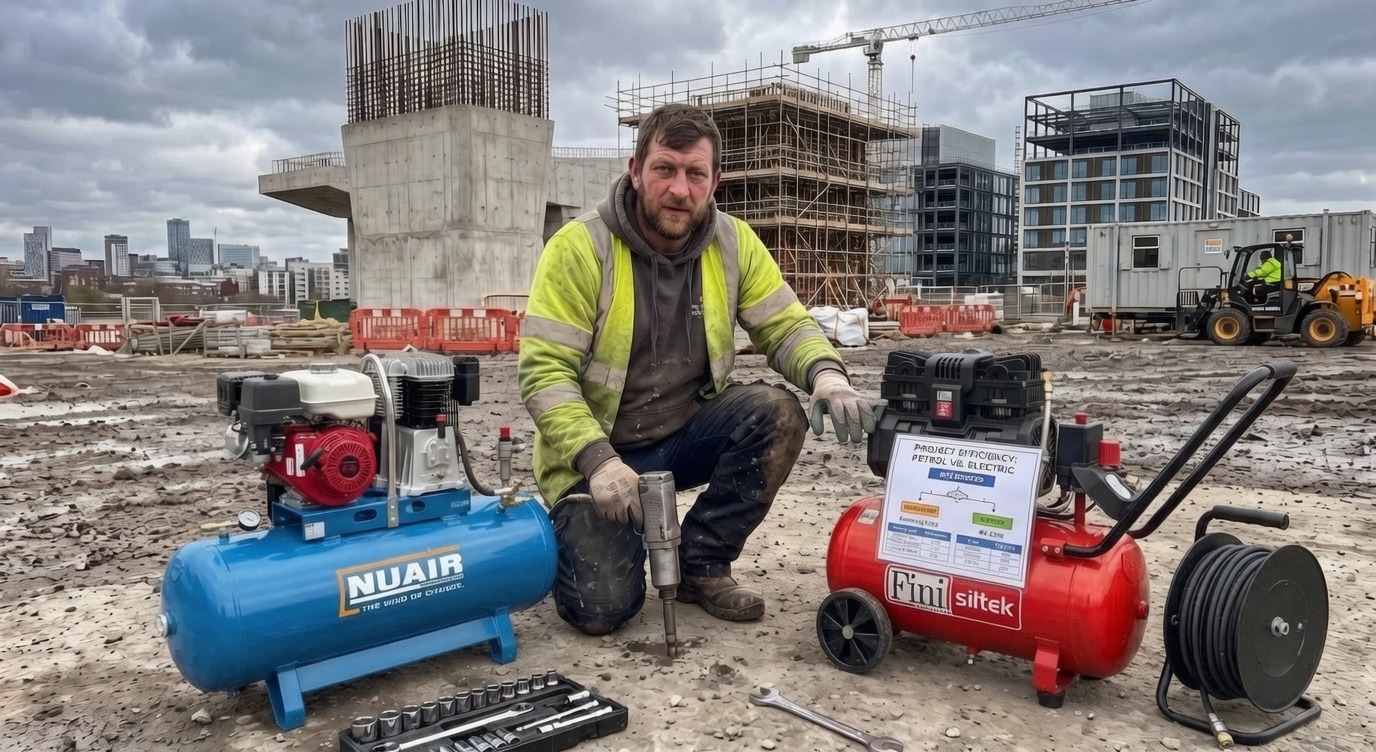
These models illustrate three different compact-compressor formats. Check each live product page for current availability, electrical requirements and full specifications.
Need 110V for Site Work?
The Tanair TAN-PC 1.5/110/25L is a current compact 110V option with a 25L receiver and published 6.7 CFM output at up to 8 bar. It is intended for intermittent site and light pneumatic duties where a suitable 110V supply is available.
Tool CFM: Use the Exact Manufacturer Figure
Generic tables for nailers, impact wrenches, spray guns and sanders can be useful as rough orientation, but tool demand varies too much to size a compressor accurately from a universal range.
| Tool / Task | What to Check |
|---|
| Nailer / stapler | Air per shot, firing frequency and required pressure. |
| Impact wrench | Average and peak airflow plus how long the tool is used per cycle. |
| Spray gun | Published air consumption, pressure and required air quality. |
| Sander / grinder | Continuous airflow demand; these tools can exceed the capability of many small compressors. |
| Tyre inflation | Required inflation pressure, tyre size and expected frequency of use. |
| Blow gun | Nozzle size and duration; continuous blowing can consume substantial air. |
Receiver Size: What It Actually Changes
A Larger Receiver Can
- Store more compressed air.
- Help absorb short demand peaks.
- Reduce very rapid pressure fluctuations.
A Larger Receiver Cannot
- Increase the pump’s continuous CFM.
- Turn an undersized compressor into a continuous-duty machine.
- Guarantee better performance with a high-demand tool.
Oil-Free vs Oil-Lubricated
Oil-free compressors remove compressor lubricant from the compression chamber and can reduce routine oil-related maintenance. They do not automatically provide dry or process-grade air.
Oil-lubricated piston compressors can be suitable for workshop use where the intended duty and maintenance requirements match the application. Neither type is automatically “better” for every user.
For Spray Painting, Think Beyond the Compressor
Good paint results depend on stable airflow and suitable air quality. Even an oil-free compressor draws in atmospheric moisture and particles, so water separation, filtration and sometimes drying may still be required.
Check the spray gun specification first. The compressor must sustain the gun’s air consumption at the required pressure for the duration of the spraying task.
Quiet Compressors: Compare Published dB(A)
“Silent” and “quiet” are useful product descriptions, but the published sound figure is the better comparison. The Fini SILTEK S 6 and SILTEK TB Super Quiet 24 are currently listed at 59 dB(A).
Installation location also matters. Hard walls, corners and enclosed spaces can change how noise is perceived, while ventilation clearances must still be maintained.
230V Does Not Automatically Mean a Normal 13A Plug
Many compact compressors use 230V single-phase power, but buyers should still check the exact starting current, plug, cable and manufacturer connection requirements. Do not assume every 230V compressor can be connected to any domestic socket or extension lead.
Maintenance
- Follow the manufacturer’s service and inspection schedule.
- Drain condensate as instructed for the specific receiver and use pattern.
- Keep intake filters and cooling paths clean.
- Inspect hoses and fittings for damage or leakage.
- Do not block ventilation around the compressor.
- Investigate repeated overheating, tripping or pressure problems rather than repeatedly resetting the machine.
Useful Small Compressor Routes
Small Air Compressor FAQs
What is the best small compressor for home use?
The best model depends on the tools you want to run, their airflow and pressure requirements, how often they are used, available electrical supply, noise limits and storage space.
Is 6–24 litres enough for DIY?
Receiver size alone cannot answer that. Check the compressor’s usable airflow against the exact tool demand and duty cycle.
Is oil-free better for spray painting?
Not automatically. Oil-free compression removes one lubricant source, but moisture and particles still need to be controlled where the finish requires it.
Can a small compressor run an impact wrench?
Some can for intermittent use, but impact-wrench airflow varies by model. Check the exact tool specification against compressor output.
Does a 50L receiver give more CFM than a 24L receiver?
No. Receiver size changes stored-air capacity, not pump output.
Are quiet compressors under 70 dB?
Some are, but not all. Compare the manufacturer’s published dB(A) figure for each model.
Should I use PCL or Euro/XF fittings?
Use a compatible coupling profile sized for the airflow required. Euro/XF has a larger nominal bore than PCL Standard and can be useful where coupling restriction matters.
Not Sure Which Small Compressor Fits Your Tools?
Send us the tool makes and models, required pressure, how often they run and whether you have 230V or 110V available. We can help check the compressor before you buy.
Compressed Air Systems UK · Unit 15, Fortnum Close, Birmingham, B33 0LG