“Portable” Covers Very Different Machines
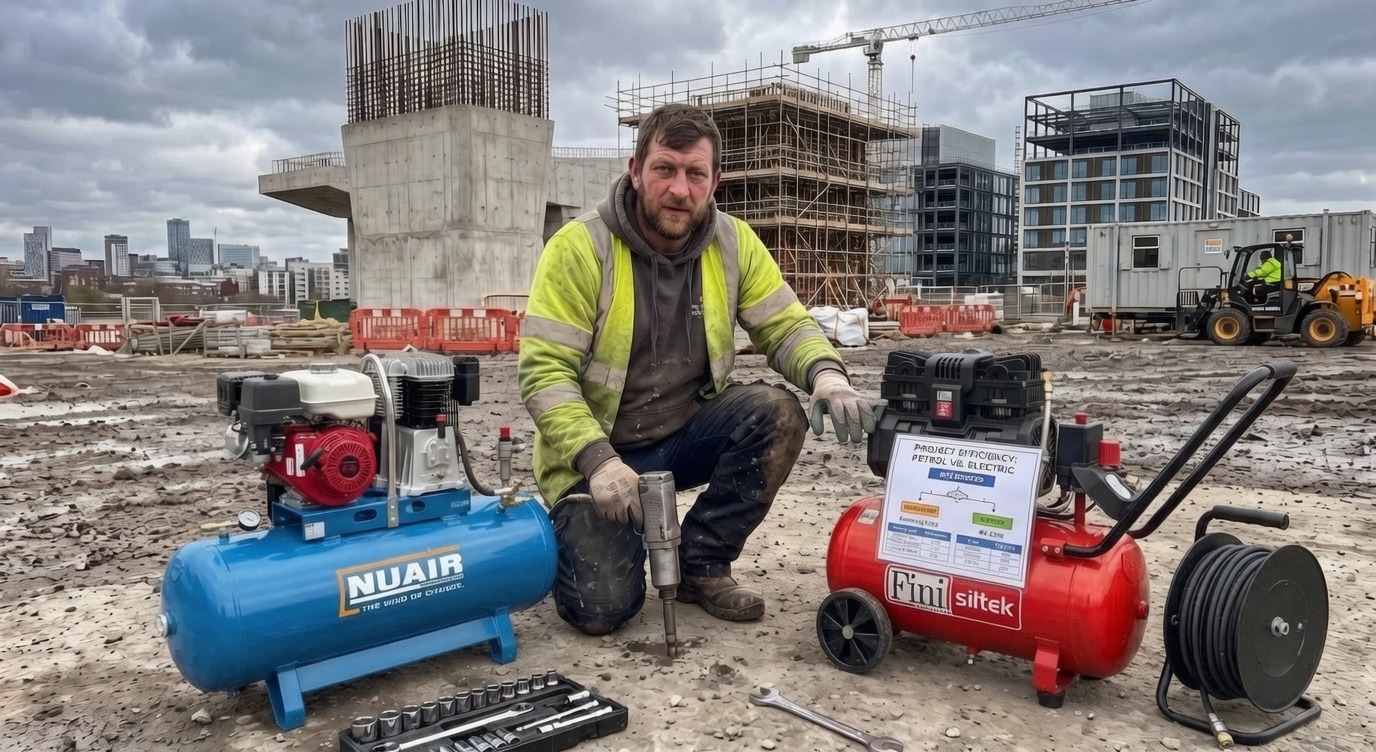
A compact 12V tyre inflator, a 16 kg 230V workshop compressor, a 26 kg 110V site compressor and a petrol receiver-mounted unit may all be described as portable, but they are designed for very different duties.
Choose by application first. Decide what needs compressed air, how much airflow it requires, the operating pressure, duty cycle and available power source. Portability comes after those essentials.
Four Main Portable Compressor Formats
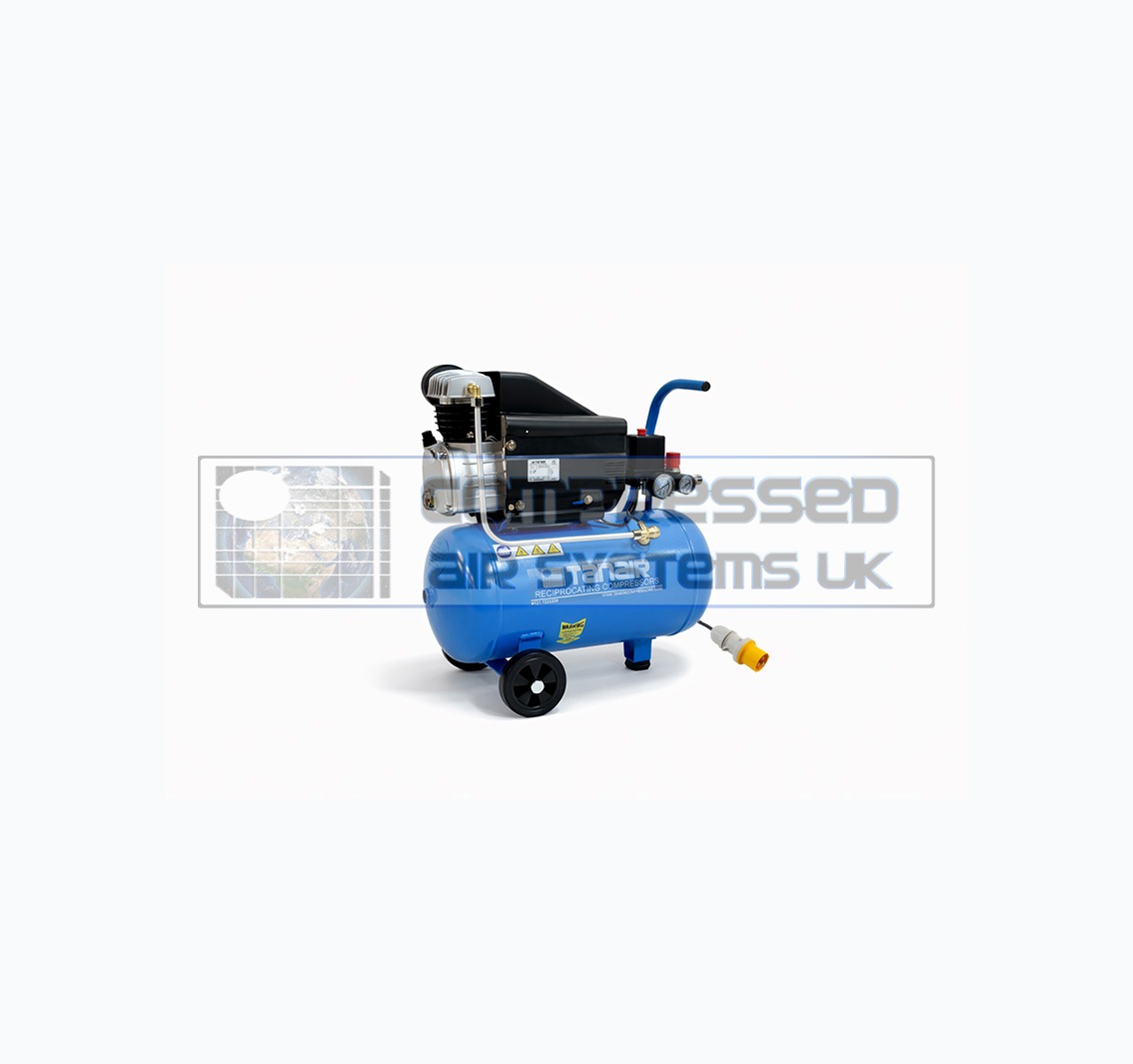
Compact 230V ElectricUseful for garages, workshops, maintenance and lighter pneumatic duties where mains power is available.
110V Site CompressorDesigned for locations using a suitable 110V site supply, with airflow matched to intermittent tools and maintenance tasks.
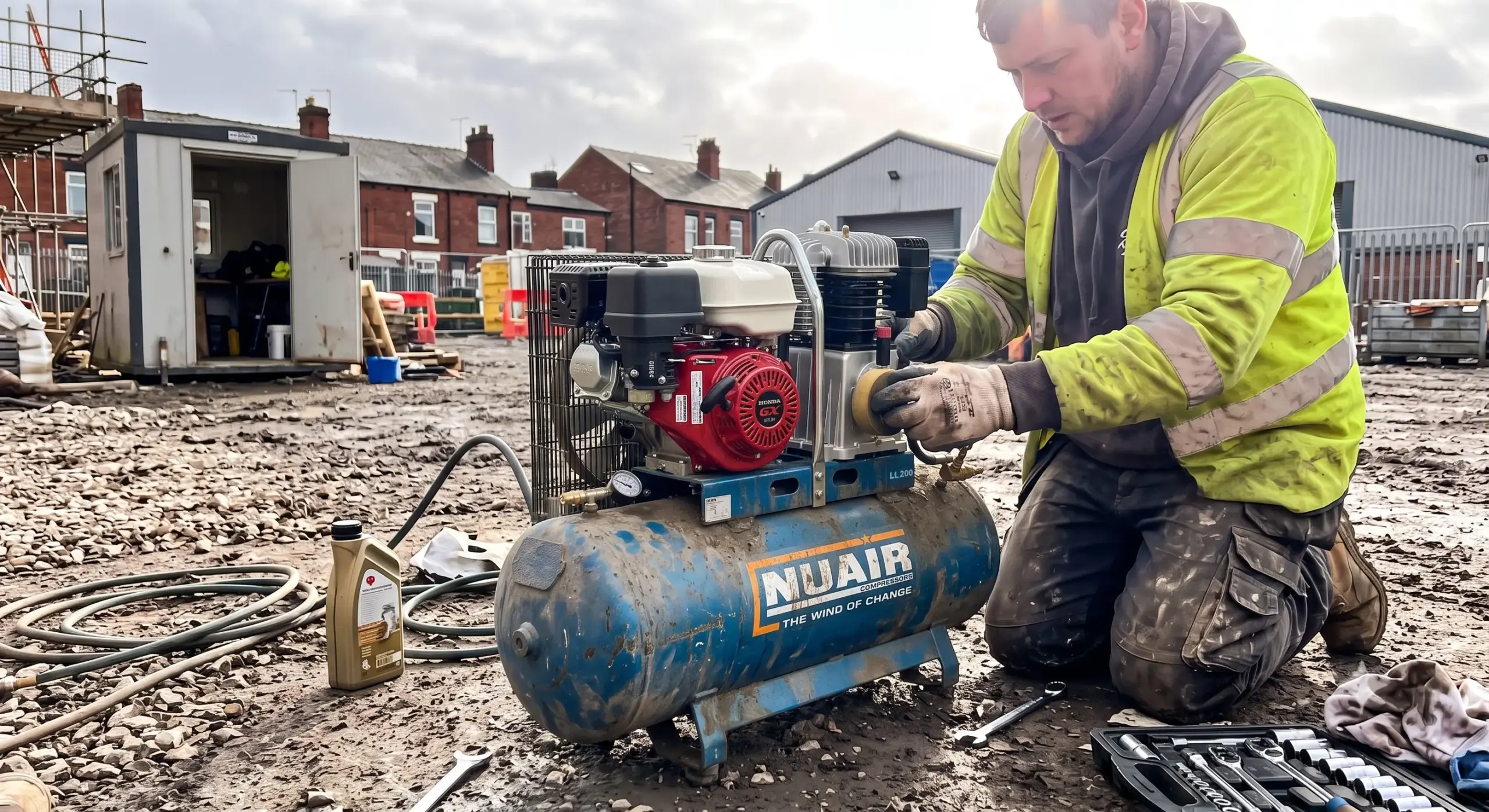
Petrol / Engine DrivenUseful where mains electricity is unavailable, subject to safe outdoor positioning and exhaust-gas controls.
12V / Battery InflatorPrimarily an inflation device for tyres and recreational equipment rather than a substitute for a receiver-mounted workshop compressor.
Current Portable Compressor Options
These current models show how portable compressors differ in power supply, airflow, receiver size and intended use.
Portable Compressors at Work
Common Suitable Tasks
- Tyre inflation
- Nailers and staplers when correctly sized
- Blow guns for short-duration use
- Light maintenance tools
- Mobile service work
Tasks That Need Careful Sizing
- Air sanders and grinders
- Continuous spray equipment
- Large impact tools
- Blasting equipment
- Multiple simultaneous tools
Do Not Size from a Generic “2–5 CFM” Rule
Pneumatic tools vary greatly in airflow consumption. A nailer can use air intermittently while a sander may draw air almost continuously. Two tools both labelled “90 PSI” can therefore need very different compressors.
Use the tool manufacturer’s airflow requirement at the stated pressure and consider how long the tool will run. Where multiple tools may run together, assess simultaneous demand.
Receiver Size Does Not Create More Continuous CFM
A larger receiver stores more compressed air and can help with short peaks. It does not increase the pump’s continuous output.
If a tool consumes more air than the compressor can continuously provide, the receiver will eventually empty faster than the compressor can refill it.
Construction & Mobile Maintenance
Portable compressors can be valuable on construction and maintenance work where the air source needs to move with the job. For sites using 110V equipment, select a compressor designed for the actual supply and confirm transformer, plug and circuit requirements.
Mobility should not be confused with weatherproofing. Unless the manufacturer specifically approves outdoor exposure, protect electric compressors from rain, standing water and unsuitable environmental conditions.
Automotive & Mobile Service Work
Tyre inflation, blow-down and intermittent air-tool use are common portable-compressor applications. For mobile mechanics, check that the vehicle, generator or customer supply can safely support the compressor’s electrical starting demand.
For high-demand tyre-shop or continuous workshop use, a larger fixed compressor may be more suitable than repeatedly pushing a compact portable model to its duty limit.
Camping, Cycling & Off-Road Use: Choose the Right Type
For bicycle tyres, air mattresses, sports equipment and similar recreational inflation, a small dedicated inflator is often more practical than a receiver-mounted workshop compressor.
Off-road tyre reinflation can require higher duty and airflow, particularly with large 4x4 tyres. Use an inflator specifically rated for the tyre size, pressure and required continuous run time.
Check the pressure requirement of the inflatable. High-volume low-pressure equipment such as paddleboards, mattresses and some watercraft may need a purpose-designed inflator rather than a conventional workshop compressor.
Petrol Compressors for Remote Work
Petrol engine-driven compressors provide compressed air where a suitable electrical supply is unavailable. They can suit agricultural, site and mobile duties when correctly sized.
Carbon monoxide risk: petrol and diesel engine-driven compressors must not be operated indoors or in enclosed or poorly ventilated areas where exhaust gases can accumulate. Follow the engine and compressor manufacturer’s siting instructions.
Oil-Free vs Oil-Lubricated Portable Compressors
Oil-free compressors avoid compressor-oil changes and remove the risk of compressor lubricant spilling from the pump during transport. They are not maintenance-free, and they do not automatically provide dry or contaminant-free compressed air.
Oil-lubricated piston compressors can suit more demanding duties where their specific design and service requirements match the application.
What About Rotary Screw, Vane and Scroll?
Portable receiver-mounted workshop compressors are most commonly reciprocating piston machines. Rotary screw compressors are generally used where higher and more continuous airflow is required, although portable engine-driven screw compressors also exist for heavy site duties.
Rotary vane and scroll are different technologies. Vane compressors use sliding vanes within an eccentric rotor; scroll compressors use interleaving spiral scroll elements. They should not be described as the same compressor type.
Single-Stage and Two-Stage Compressors
Single-stage and two-stage describe how compression is carried out, but there is no universal pressure limit that applies to every design. Use the manufacturer’s rated maximum pressure and performance data for the exact model.
Two-stage piston compressors are commonly used where higher pressure or heavier duty is required, but suitability still depends on the complete machine specification.
Direct Drive vs Belt Drive
Direct Drive
Connects the motor and compressor pump directly or coaxially. It can produce a compact package well suited to portable designs.
Belt Drive
Uses pulleys and a belt between the motor and pump, allowing different rotational speeds and larger workshop configurations.
Neither drive arrangement automatically guarantees quieter operation, longer life or lower maintenance. Compare the actual model design and manufacturer specification.
Portable Compressor Buying Checklist
| Check | Why It Matters |
|---|
| Required airflow | Use the exact tool or process demand rather than a generic CFM band. |
| Working pressure | Confirm required pressure while air is flowing, allowing for hose and fitting losses. |
| Duty cycle | Continuous tools may exceed what a small portable piston compressor can sustain. |
| Power source | 230V, 110V, petrol and battery units serve different applications. |
| Weight & dimensions | Check whether “portable” means hand-carried, wheeled or vehicle-transported for your use. |
| Noise | Use the published dB(A) figure and consider where the machine will operate. |
| Air quality | Sensitive applications may require filtration and drying beyond the compressor itself. |
Portable Compressor Safety
- Inspect electrical cables, hoses and fittings before use.
- Use the electrical supply and protection specified by the manufacturer.
- Keep electric compressors away from water unless specifically designed and rated for the environment.
- Never direct compressed air at people.
- Wear appropriate eye and hearing protection for the task.
- Isolate and release trapped pressure before disturbing hose or fittings.
- Operate combustion-engine compressors only where exhaust gases can disperse safely.
Useful Portable Compressor Guides
Portable Air Compressor FAQs
Can one portable compressor handle work tools and camping inflatables?
Sometimes, but the requirements can be very different. Pneumatic tools need adequate CFM at working pressure, while many large inflatables need high-volume low-pressure air. Check each application separately.
Is 2–5 CFM enough for most air tools?
No universal range covers most tools. Nailers, impact wrenches, spray guns, sanders and grinders can have very different airflow and duty requirements.
Does a larger tank make a portable compressor more powerful?
No. A larger receiver stores more air but does not increase continuous compressor output.
Can I use a 230V compressor outdoors?
Only in conditions allowed by the manufacturer and with a safe, suitable electrical supply. Do not assume a portable compressor is weatherproof.
Can I run a petrol compressor inside a garage?
Engine-driven compressors produce carbon monoxide and other exhaust gases. They must not be operated in enclosed or poorly ventilated areas where exhaust can accumulate.
Is an oil-free compressor maintenance-free?
No. Oil-free refers to the compression mechanism; filters, drains, cooling, electrical components and other service items still require inspection and maintenance.
Is a tyre inflator the same as a portable air compressor?
Both compress air, but a compact tyre inflator is normally intended for inflation rather than operating conventional workshop pneumatic tools.
Need a Portable Compressor for Work or Site Use?
Send us the tool or application, required airflow, pressure, operating time and available power supply. We can help distinguish between a compact 230V unit, 110V site compressor or engine-driven option.
Compressed Air Systems UK · Unit 15, Fortnum Close, Birmingham, B33 0LG