
Compact Home / Hobby
Fini SILTEK S 6 SILENT
3.7 CFM • 6L • 230V • compact silent compressor.
View ProductAn air compressor can become one of the most useful pieces of equipment in a garage, workshop or business — from tyre inflation and cleaning to spray work, pneumatic tools and continuous industrial production.
The strongest reason is versatility. One correctly sized compressed-air source can support many different tools and jobs without needing a separate powered machine for every task.
For a home user that might mean inflation, airbrushing, cleaning or a nail gun. In a garage it may include impact wrenches, tyre equipment and spray work. In industry, the same principle scales up to production machinery, automation and continuous pneumatic systems.
Instead of repeating the old article images, this version uses a different selection of current Tanair-hosted compressor imagery to show how broad the range can be.
Compact & Silent
Useful where portability and lower noise matter more than high continuous airflow.
 Wall-Mounted Convenience
A fixed compressed-air point can be useful where garage floor space is limited.
Wall-Mounted Convenience
A fixed compressed-air point can be useful where garage floor space is limited.
 Workshop Piston Compressor
Receiver-mounted piston compressors offer a practical route for intermittent workshop demand.
Workshop Piston Compressor
Receiver-mounted piston compressors offer a practical route for intermittent workshop demand.
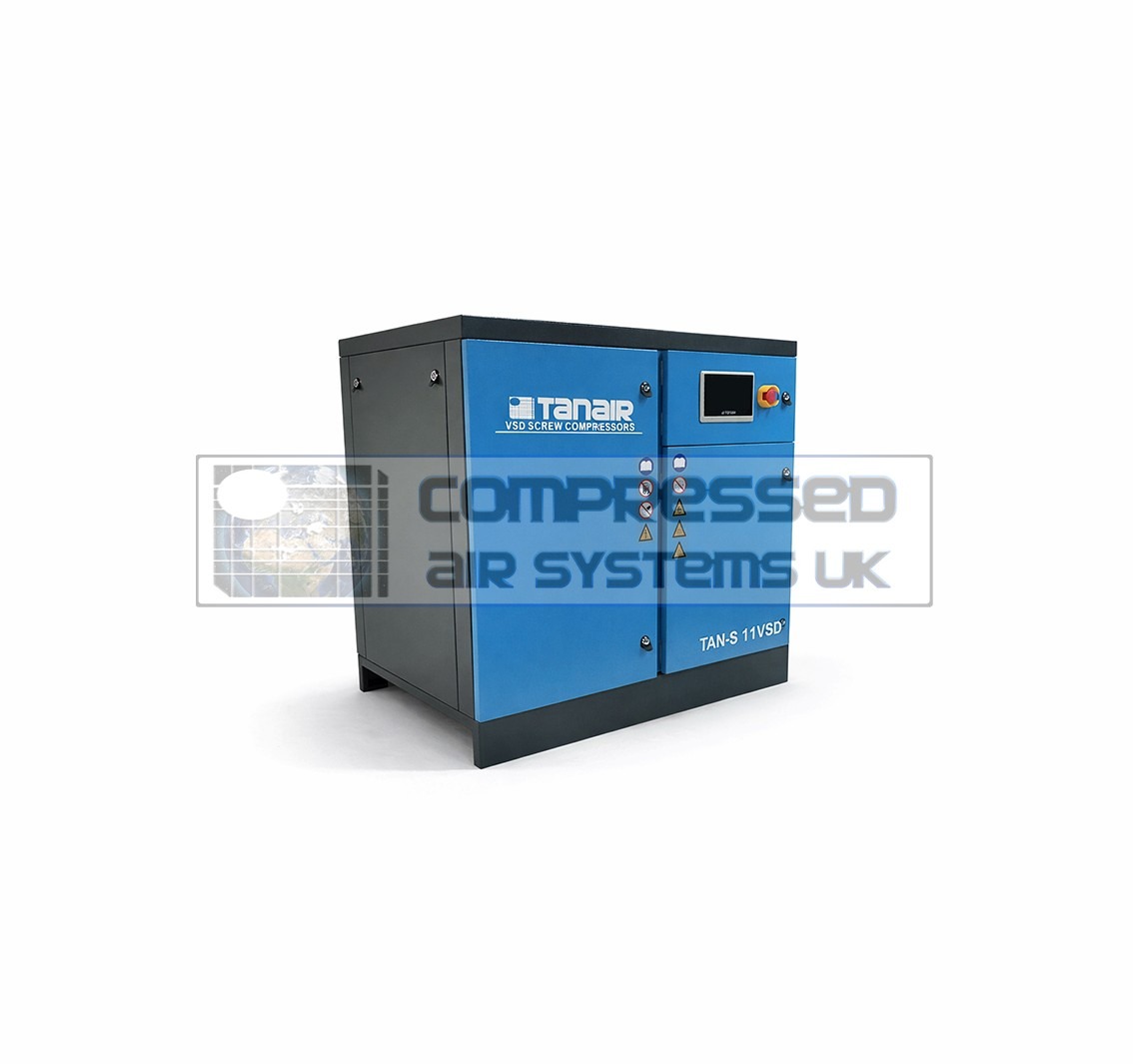 Industrial VSD
For regular industrial demand, rotary screw and variable-speed technology offers a completely different level of duty.
Industrial VSD
For regular industrial demand, rotary screw and variable-speed technology offers a completely different level of duty.
Air-powered tools are often compact and straightforward because their driving power comes from the compressor rather than a large motor inside every tool.
Best where the compressor needs to move between jobs, vehicles or work areas. Smaller receiver sizes are easier to store but provide less stored air.
A larger receiver-mounted or wall-mounted compressor can become a permanent garage air source with hose reels or fixed distribution.
Many pneumatic tools have a relatively simple mechanical design compared with an equivalent tool containing its own electric motor and battery system. For regular workshop users, that can make compressed air a very practical tool platform.
However, the cost of the compressor, hose system and electricity should be considered as part of the overall setup rather than assuming pneumatic tools are automatically cheaper.
For manufacturers and engineering sites, compressed air operates more like a utility than an individual tool. One system can supply multiple production areas, pneumatic cylinders, actuators, assembly tools and process equipment.
3.7 CFM • 6L • 230V • compact silent compressor.
View Product
6.3 CFM • 230V • wall mounted • oil-free • integrated hose reel.
View Product
9.2 CFM • 50L • 230V • useful general workshop compressor.
View Product
11 kW • 46 CFM • 10 Bar • 415V • PM variable-speed screw compressor.
View ProductThe old article suggested a general tank and motor-size range. A more reliable approach is to start with the tools you actually want to run.
If you regularly inflate tyres, use pneumatic tools, spray, airbrush or work on vehicles, owning a compressor can be very convenient. For a one-off task, ownership may be unnecessary.
Delivered airflow is usually the first figure to compare because the compressor must provide enough CFM for the tool or process. Working pressure and duty are equally important.
It can be for many intermittent workshop tasks, but receiver litres alone cannot answer the question. Check the compressor's delivered CFM against your highest-demand tools.
They can be particularly useful in home garages, dental/laboratory areas and workplaces where noise matters, provided the compressor still delivers the airflow and duty required.
Oil-free compressors are useful where low maintenance or a specific air-quality requirement matters. Lubricated piston compressors remain a strong choice for many general workshop applications.
The existing Compressed Air Systems UK, telephone and Birmingham contact route remains part of the updated article.
Offices, Trade Counter & Warehouse
Compressed Air Systems UK
Unit 15, Fortnum Close
Birmingham, B33 0LG
Call 0121 753 3330 or use the Contact Us page if you need help choosing a compressor.
Start with what you want to power, then match the compressor to the required CFM, pressure, duty and available electrical supply.